Four New Mexico Tribes Just Won a Federal Injunction Against Kalshi: Inside the Landmark IGRA Ruling
Hours after Kalshi caught a temporary breather in New York state court on Monday, November 23, 2026, a federal judge in New Mexico dropped a legal hammer that may prove far more dangerous to the prediction market giant than any state attorney general's lawsuit.
In a 29-page opinion filed Monday in the U.S. District Court for the District of New Mexico (Mescalero Apache Tribe, Pueblo of Isleta, Pueblo of Pojoaque, and Pueblo of Sandia v. Kalshi, Inc., and KalshiEX, LLC, Case No. 2:26-cv-01517-MIS-GJF, Document 67), U.S. District Judge Margaret I. Strickland handed four federally recognized New Mexico Tribes a decisive victory: she denied Kalshi's motion to dismiss and granted the Tribes' motion for a preliminary injunction.
For anyone tracking prediction market law on Predictions Market Fans, this ruling is a watershed moment for one simple reason: tribal lawsuits do not play by the same rules as state lawsuits.
When New York, Maryland, or Nevada sues Kalshi, the exchange leans on the U.S. Constitution's Supremacy Clause, arguing that the federal Commodity Exchange Act (CEA) overrides state gambling laws. When sovereign Native American Tribes sue under the Indian Gaming Regulatory Act (IGRA), that preemption shield vanishes. IGRA is a co-equal federal statute enacted by Congress in 1988. Kalshi cannot wave federal preemption to erase another federal law.
Worse still for Kalshi, Judge Strickland did not act alone. She explicitly aligned her courtroom inside the Tenth Circuit with the Ninth Circuit's landmark September 16, 2026 appellate ruling in Blue Lake Rancheria v. Kalshi, Inc., turning what was once a California legal problem into a multi-circuit federal blueprint that Tribes nationwide can copy and paste.
Here is the complete breakdown of the four legal pillars inside Judge Strickland's 29-page order, the stunning 30,000 casino Wi-Fi visits that dismantled Kalshi's main factual defense, and what this ruling means for geofencing and sports contracts across Indian Country.
1. The Case Timeline: Six Months From Filing to Injunction
Unlike rushed emergency TRO battles in state courts, the New Mexico federal injunction came after a full, methodical six-month briefing schedule and live oral argument:
May 12, 2026: Four New Mexico Tribes, the Mescalero Apache Tribe, Pueblo of Isleta, Pueblo of Pojoaque, and Pueblo of Sandia, filed suit against Kalshi, Inc. and KalshiEX, LLC in federal court in New Mexico.
June 24, 2026: Kalshi moved to dismiss the complaint (ECF No. 21), arguing that the Tribes lacked a cause of action against a non-tribal exchange and that the CFTC held exclusive jurisdiction under the CEA.
July 22, 2026: The Tribes fired back with a consolidated Motion for Preliminary Injunction (ECF No. 23), backed by sworn declarations from casino IT directors documenting massive Kalshi traffic inside their resorts.
August 19 & September 4, 2026: Full opposition and reply briefs were filed alongside two amicus briefs (ECF Nos. 36-1, 48-1).
September 23, 2026: Judge Strickland heard oral argument on both motions (ECF No. 64).
November 23, 2026: Judge Strickland issued her 29-page order (Document 67) denying dismissal outright and granting the preliminary injunction.
Because this ruling followed full briefing, sworn evidentiary declarations, and oral argument, Kalshi cannot dismiss it as an unfair ex parte ambush the way it fought back in New York earlier that same afternoon.
2. Inside the 29-Page Order: The Four Legal Pillars That Blocked Kalshi
Judge Strickland's opinion systematically dismantled every major legal defense Kalshi has deployed across the country. Her ruling rests on four interlocking legal pillars.
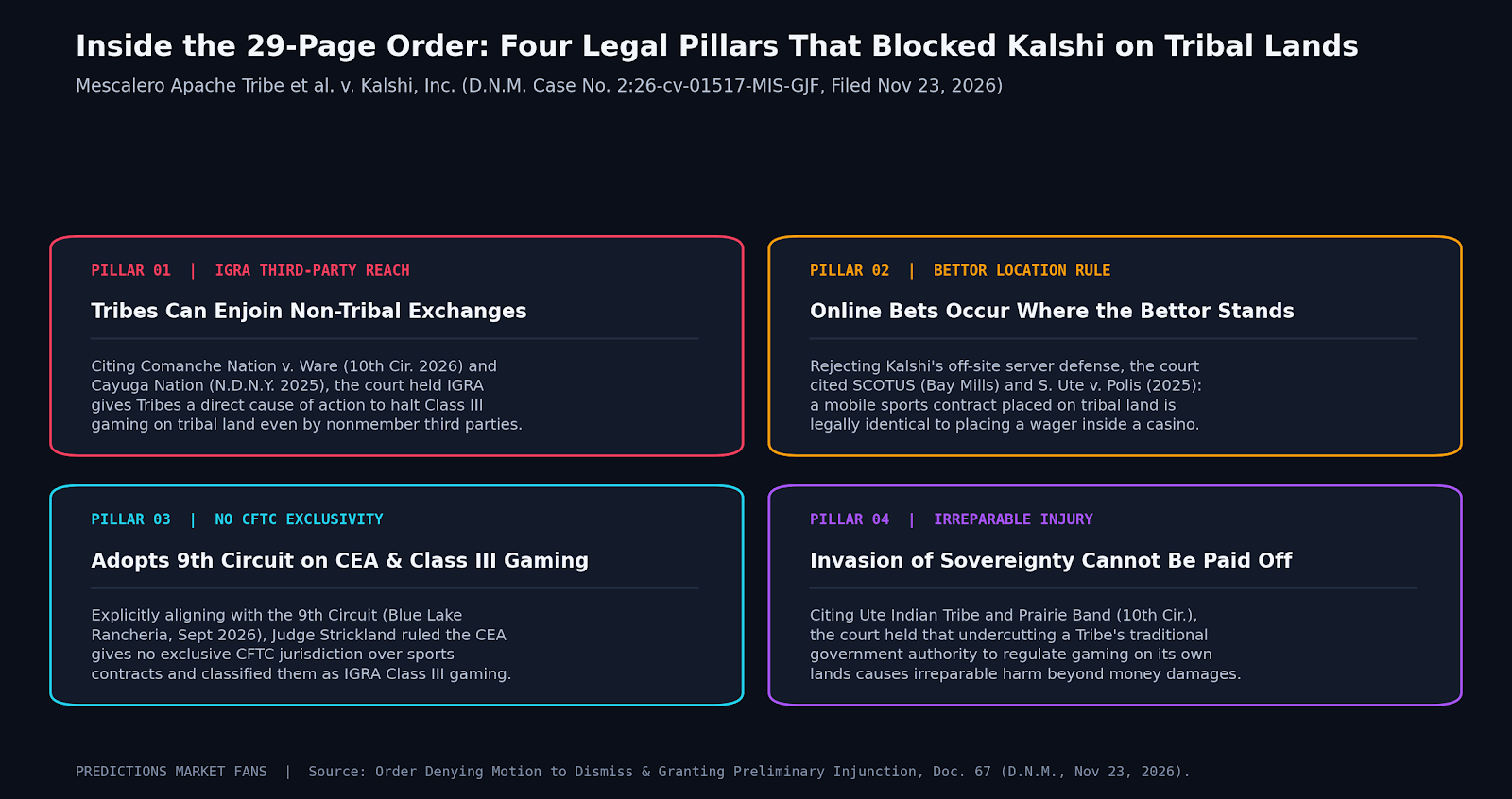
Pillar 1: IGRA Gives Tribes a Direct Weapon Against Third-Party Exchanges
Kalshi argued that IGRA only governs disputes between Tribes and states that are parties to a tribal-state gaming compact, meaning a Tribe cannot use IGRA to sue an outside, nonmember financial exchange.
Judge Strickland rejected that argument flatly. Citing Cayuga Nation v. N.Y. State Gaming Comm'n, 775 F. Supp. 3d 651, 666 (N.D.N.Y. 2025), she emphasized that IGRA's restrictions on Class III gaming apply to any Class III gaming activity conducted on Indian lands. She then pointed to binding Tenth Circuit precedent decided earlier this year, Comanche Nation v. Ware, 174 F.4th 717, 728-31 (10th Cir. 2026), where the appeals court confirmed a Tribe could seek to enjoin a third party's unauthorized Class III gaming operations even when that party was not a signatory to the compact.
Her conclusion was unmistakable: IGRA provides Tribes a federal cause of action to enjoin unauthorized Class III gaming on their lands even when conducted by a third-party entity like Kalshi.
Pillar 2: Online Betting Happens Where the Bettor Stands, Not Where the Server Sits
For over a year, Kalshi's favorite factual defense in tribal litigation has been geographic: "Kalshi does not maintain an office on Indian lands. Kalshi does not house servers on Indian lands. Kalshi does not employ personnel on Indian lands. Kalshi conducts no business whatsoever on Indian lands".
Judge Strickland tore that defense apart. Relying on a sister Tenth Circuit district ruling, Southern Ute Indian Tribe v. Polis, 810 F. Supp. 3d 1203, 1208 (D. Colo. 2025), and the U.S. Supreme Court's landmark decision in Michigan v. Bay Mills Indian Community, 572 U.S. at 792, she ruled that Class III gaming activity refers to "the stuff involved in playing class III games," not off-site server administration.
"A Kalshi user purchasing a sports event contract on Kalshi's site while physically located on tribal lands, by the Court's estimation, is no different than a bettor placing a wager at a casino: it occurs where the bettor is located."
Read that sentence twice. If the location of the user's smartphone determines where the gaming occurs, then every time a bettor opens the Kalshi app on reservation land, the exchange is legally conducting Class III gaming inside sovereign tribal territory.
Pillar 3: Expressly Adopting the Ninth Circuit on CEA Exclusivity and Class III Gaming
The single most consequential paragraph in the entire 29-page order is also the shortest. Referencing the Ninth Circuit's September 16, 2026 decision in Blue Lake Rancheria v. Kalshi, Inc., Judge Strickland wrote:
"Here, the Court agrees with the Ninth Circuit on both fronts and will not chart a different path. The Court finds that the CEA does not provide the CFTC exclusive jurisdiction over Kalshi's sports-event contracts. The Court also finds that Kalshi's sports event contracts qualify as class III gaming activity under IGRA, and thus the Tribes are not precluded from seeking to enforce their gaming laws."
Just two months ago, the Ninth Circuit reversed a Northern California district judge and held that California tribes (Blue Lake Rancheria, Chicken Ranch Rancheria, and Picayune Rancheria) were likely to succeed on their IGRA claims against Kalshi. Now, a federal court inside the Tenth Circuit has adopted that exact framework word for word.
Pillar 4: Invading Tribal Sovereignty Is Automatically Irreparable Injury
To win a preliminary injunction, a plaintiff must prove not just that they are likely to win the case, but that waiting until final trial would cause irreparable injury that money cannot fix.
In New York state court earlier on November 23, Justice Melissa Crane questioned whether New York really faced urgent irreparable harm when adults 21 and older can already legally bet on sports in the state. In tribal federal court, that hurdle disappears. Citing Tenth Circuit precedent in Ute Indian Tribe of the Uintah & Ouray Reservation v. Utah (790 F.3d 1000), Wyandotte Nation v. Sebelius (443 F.3d 1247), and Prairie Band (253 F.3d 1242), Judge Strickland emphasized that "an invasion of tribal sovereignty can constitute irreparable injury."
Because regulating gaming on tribal lands is a traditional government function explicitly backed by Congress since IGRA's passage in 1988, and exercised by several of these New Mexico Tribes for decades before that, allowing Kalshi to operate unlicensed sports markets on reservation soil inflicts a sovereign injury that no financial damages award can repair.
3. The Smoking Gun: ~30,000 Visits to Kalshi on Tribal Casino Wi-Fi in Just Three Weeks
Legal doctrines win motions to dismiss, but hard empirical evidence wins injunctions. And the New Mexico Tribes brought a factual bombshell to court that left Kalshi with nowhere to hide.
Rather than relying on vague guesses about whether reservation residents might be using prediction markets, three Information Technology Directors working for casinos and resorts on Pueblo of Isleta, Pueblo of Pojoaque, and Pueblo of Sandia tribal lands pulled their network logs and filed sworn declarations under penalty of perjury:
Erick Mendoza (ECF No. 23-4)
Guadalupe Flores (ECF No. 23-6)
Brandon Hurtado (ECF No. 23-8)
Together, those three IT Directors documented approximately 30,000 visits to Kalshi's website over a single three-week period on their respective casino and resort Wi-Fi networks alone.
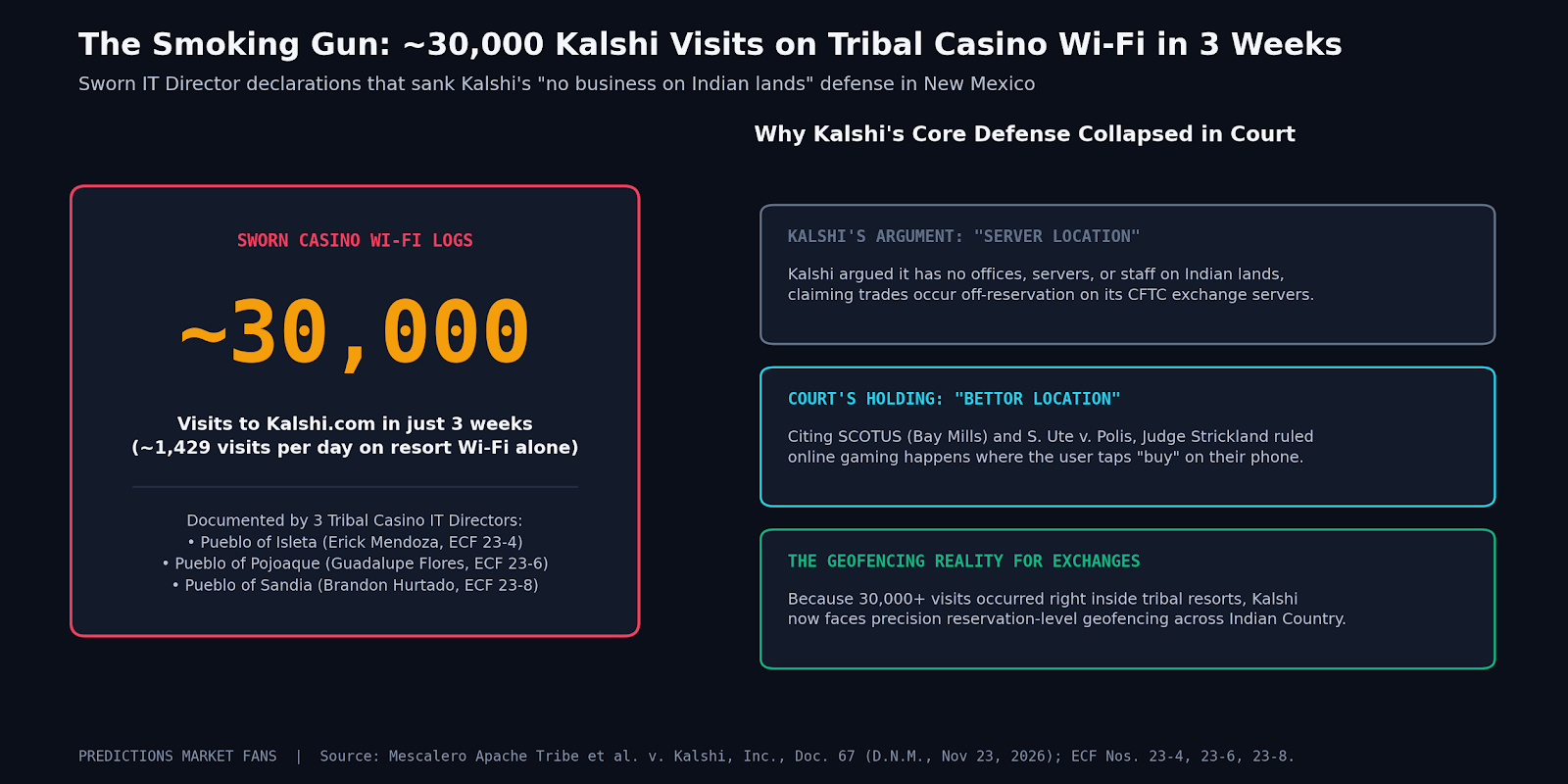
Pause and appreciate what that number represents. That roughly 1,429 visits per day does not even count cellular 5G traffic, home broadband connections across the reservations, or traffic on the Mescalero Apache reservation. That is strictly guests and patrons sitting inside tribal casinos and resorts, connected to the Tribe's own Wi-Fi, pulling up Kalshi's website right next to regulated Class III gaming floors.
Judge Strickland noted in her order that it was undisputed that users were freely accessing Kalshi and placing stakes on sports-event contracts while physically located on the Tribes' lands. Once the court established that online betting occurs where the bettor stands, those 30,000 Wi-Fi hits turned the preliminary injunction into a slam dunk.
4. Why Tribal IGRA Lawsuits Are Kalshi's Most Dangerous Legal Front
To understand the true stakes of Monday's ruling, compare the two fronts of Kalshi's nationwide legal war.
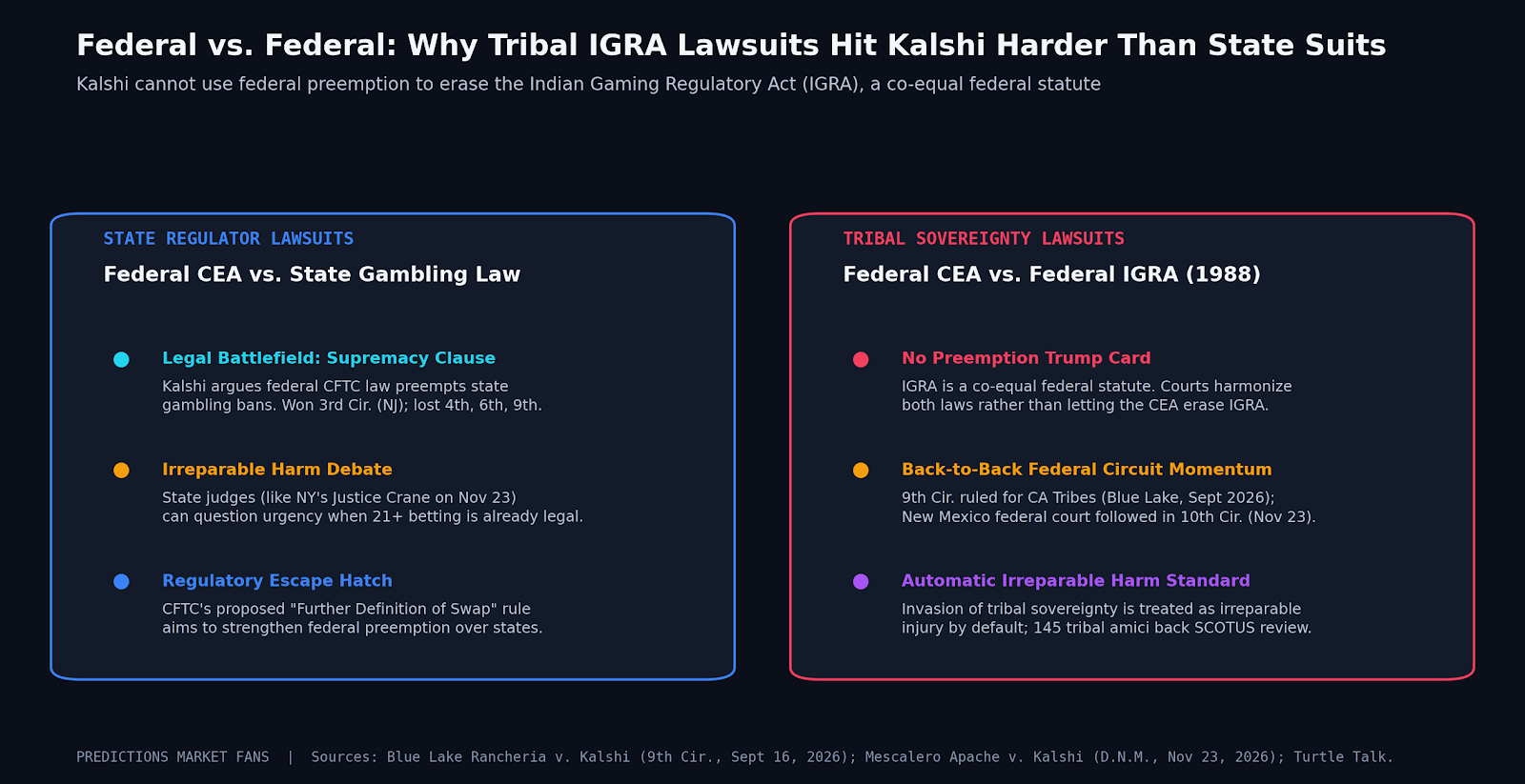
In state litigation (such as New Jersey, Maryland, New York, Nevada, and Michigan), Kalshi's core strategy is federal preemption: arguing that Congress gave the CFTC exclusive authority over swaps, wiping out conflicting state gambling statutes. That strategy won Kalshi a major victory in the Third Circuit (New Jersey) and gives CFTC Chairman Michael Selig room to push his proposed "Further Definition of Swap" rule to fortify federal preemption against state attorneys general.
In tribal litigation, that entire playbook hits a brick wall:
No Supremacy Clause Trump Card: IGRA is a federal statute passed by Congress, standing on equal footing with the Commodity Exchange Act. Federal courts must harmonize the two laws rather than letting a CFTC rule erase tribal statutory rights under IGRA.
Kalshi's Own 2024 Words Are Being Used Against It: As Wisconsin's Ho-Chunk Nation pointed out in its federal complaint against Kalshi and Robinhood, back in 2024 when Kalshi was fighting the CFTC for the right to list political election contracts, Kalshi's own lawyers told federal courts that "Congress did not want sports betting to be conducted on derivatives markets" and pointed to events like the Super Bowl and Kentucky Derby as classic examples of prohibited gaming. Tribes are quoting those exact 2024 briefs back to judges in 2026.
A Nationwide Tribal Wave Is Already Mobilized: In October 2026, a massive coalition of 145 tribal amici petitioned the U.S. Supreme Court to take up the Kalshi dispute immediately. With the Ninth Circuit (Blue Lake Rancheria) and now a federal court in the Tenth Circuit (New Mexico) both ruling that sports event contracts are Class III gaming under IGRA, every one of the more than 240 gaming Tribes across the United States now has a clear, court-tested blueprint to pull their resort Wi-Fi logs and demand immediate federal injunctions.
5. The Operational Nightmare: Reservation-Level Geofencing and What Traders Should Expect
For everyday traders on Predictions Market Fans, the immediate impact of Judge Strickland's order is technical and geographic: precision geofencing.
Blocking an entire state like Michigan or Louisiana is relatively straightforward using standard IP and GPS geofencing vendors. Blocking hundreds of non-contiguous tribal reservations, trust lands, and casino resort footprints scattered across states like New Mexico, California, Oklahoma, Arizona, and Wisconsin is a vastly harder engineering challenge. Many tribal lands feature complex "checkerboard" boundaries where reservation trust parcels sit directly beside non-tribal towns and highways.
To comply with Monday's preliminary injunction without risking contempt of court, Kalshi must deploy high-precision geolocation fencing around the Mescalero Apache, Isleta, Pojoaque, and Sandia lands for sports-event contracts. If additional Tribes in Oklahoma, Arizona, California, and Wisconsin win parallel injunctions using the exact same IGRA playbook, prediction market exchanges will face a Swiss-cheese map of hundreds of micro-geofenced zones across the United States.
For traders, three practical takeaways stand out right now:
If you live on or visit tribal lands in New Mexico: Expect sports-event contracts on Kalshi to be geofenced on Mescalero Apache, Isleta, Pojoaque, and Sandia territories as the injunction takes effect. Non-sports contracts (such as macroeconomics, inflation, and weather) are not classified as Class III gaming under this ruling.
Watch the Tenth Circuit appeal: Kalshi will almost certainly appeal Judge Strickland's order to the U.S. Court of Appeals for the Tenth Circuit and seek an emergency stay pending appeal. However, with the Tenth Circuit having already decided Comanche Nation v. Ware in 2026 and the Ninth Circuit having already ruled against Kalshi in Blue Lake Rancheria, the appellate odds in Denver look steep.
The Supreme Court clock just sped up: Between the 3rd vs. 4th/6th/9th Circuit split on state preemption and the growing 9th and 10th Circuit alignment on tribal IGRA sovereignty, the pressure on the U.S. Supreme Court to intervene in 2027 has reached a boiling point.
Monday, November 23, 2026 may be remembered as the day Kalshi survived a state-court scare in New York, only to learn that the hardest wall in American gaming law does not sit in Albany. It sits in Indian Country.
Editorial note: Informational and educational commentary only — not financial or trading advice. Prediction markets involve risk of loss.

Editor-in-Chief
Ezekiel Njuguna is the Editor-in-Chief of Predictions Market Fans, where he helps make probabilistic thinking clear and practical for readers. With a strong focus on quantitative research and market mechanics, he leads the site’s technical guides, including a detailed breakdown of Kalshi Combos. His writing connects economic theory with real-world trading strategy, including practical discussions of how yield-bearing tools can support active bankroll management.
The Weekly Signal
Every Friday — the week's sharpest prediction market analysis, forecasting insights, and data-driven commentary. No noise.