636 vs. 8,400: Inside the American Gaming Association's Explosive CFTC Warning Over Prediction Markets

One single paragraph buried inside a regulatory comment letter just became the sharpest weapon in the war over the future of U.S. prediction markets.
Ahead of the Commodity Futures Trading Commission's November 18, 2026 public comment deadline on its proposed event-contract rules, the American Gaming Association (AGA) fired off a blistering formal filing to Washington. While most media coverage focused on the familiar tug-of-war over whether sports event contracts count as "swaps" or "gambling," the AGA zeroed in on two hard numbers that cut straight through the legal jargon:
"The legal gaming industry is overseen by more than 8,400 dedicated state and tribal regulators with decades of experience regulating wagering markets. By comparison, the CFTC had only 636 full-time-equivalent staff positions across its entire financial markets mandate in fiscal year 2025, with subsequent staffing reductions. The Commission is neither staffed nor structured to replace this established gaming regulatory system."
That is not just a lobbying soundbite. It is a structural gut punch aimed squarely at the heart of the CFTC's bid to become the sole national referee for sports and event contracts across all 50 states.
Even more startling is the paragraph right above it in the AGA's letter, which accuses the CFTC of miscalculating the size of the market it wants to regulate by nearly 30 times, right as Kalshi crossed $98.15 billion in October 2026 monthly trading volume with roughly 86% coming from sports and parlay-style combo contracts.
For traders, founders, and anyone following Prediction Market Fans, this filing lands at a historic inflection point. Between a 263-comment federal docket, a coalition of 44 attorneys general, dozens of sovereign tribal nations, a bruising November 17 Fourth Circuit defeat for Kalshi in Maryland, and an emergency New York court hearing on November 23, the legal architecture of American prediction markets is being decided right now.
Here is the complete, data-backed breakdown of what the AGA exposed, why the CFTC is pushing forward anyway, how prediction market supporters fight back, and what the coming Supreme Court showdown means for every trader in the United States.
1. The Trigger: What the CFTC Proposed in Docket CFTC-2026-21377
To understand why the AGA, 44 attorneys general, and dozens of tribal governments unloaded on the CFTC in mid-November, you have to look at what CFTC Chairman Michael Selig put on the table one month earlier.
On October 19, 2026, the CFTC published a formal Notice of Proposed Rulemaking titled "Further Definition of Swap" (Docket CFTC-2026-21377, published at 91 Fed. Reg. 66,022). Under Chairman Selig, who withdrew the agency's restrictive 2024 event-contract proposal earlier this year, the Commission moved to widen the federal legal definition of a "swap" under the Commodity Exchange Act (CEA) so that it explicitly encompasses event contracts covering sports, politics, culture, and weather.
At the same time, the agency issued an interim rule attempting to draw a bright line: traditional casino-style gambling products, including bets placed against the house at a sportsbook, are not swaps, while exchange-traded event contracts on CFTC-regulated Designated Contract Markets (DCMs) are swaps.
Why does that single word, swap, carry multi-billion-dollar consequences?
Because under federal law, if an event contract is legally classified as a swap traded on a CFTC-regulated exchange, federal law generally preempts state gambling laws. That means platforms like Kalshi and Polymarket US can offer sports, election, and cultural event contracts nationwide across all 50 states, including massive markets like California, Texas, and Florida where traditional state-licensed sports betting remains illegal or tightly restricted.
By the time the CFTC's comment window closed on November 18, 2026, the docket had drawn 263 public comments (Straight to the Point). On one side stood the prediction market and crypto vanguard: Kalshi, Coinbase, Novig, Underdog, Andreessen Horowitz (a16z), and the Coalition for Prediction Markets. On the other stood an unprecedented wall of opposition: the American Gaming Association, the NFL, 43 state attorneys general plus the District of Columbia, and major tribal coalitions including the Indian Gaming Association, the National Congress of American Indians (NCAI), the National Tribal Gaming Commissioners and Regulators, and state tribal associations across California and Oklahoma.
2. The 636 vs. 8,400 Reality Check: Can the CFTC Actually Police National Sports Wagering?
Most legal briefs over prediction markets get bogged down in statutory grammar and decades-old Commodity Exchange Act footnotes. The AGA's filing did something far more effective: it turned the debate into a simple operational math problem.
Across the United States, legal commercial and tribal gaming is policed by more than 8,400 dedicated state and tribal regulators. Those regulators do one job, full time. They conduct deep background investigations on executives and investors, audit sportsbook pricing and integrity feeds, enforce strict 21+ age verification and geolocation rules, manage statewide self-exclusion registries for problem gamblers, and verify billions of dollars in state and tribal tax remittances.
Now look at the other side of the ledger. In fiscal year 2025, the entire Commodity Futures Trading Commission employed just 636 full-time-equivalent (FTE) staff positions, and the agency has experienced subsequent staffing reductions since then.
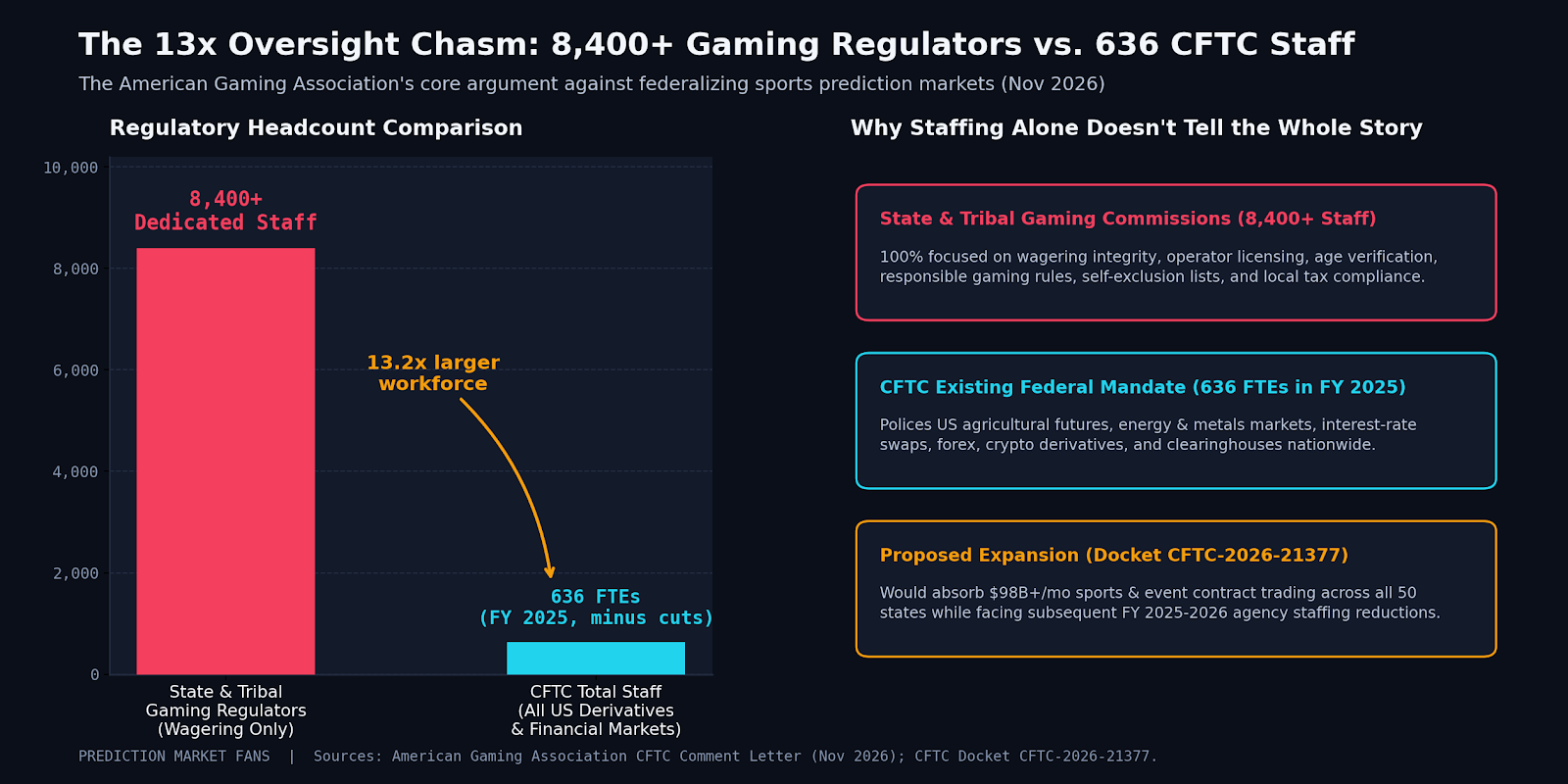
That 13.2-to-1 headcount gap actually understates the mismatch. Those 636 federal employees are not sitting around waiting to monitor NFL player props or college basketball spreads. They are already stretched thin policing the backbone of the global financial system: trillions of dollars in U.S. agricultural futures, crude oil and natural gas contracts, precious metals, interest-rate swaps, foreign exchange derivatives, major clearinghouses like CME and ICE, and an expanding mandate over digital asset markets.
The AGA's core conclusion is blunt: even if you believe the CFTC legally has jurisdiction over event contracts, it is neither staffed nor built to function as America's national sports-wagering regulator.
In their parallel November 18 comment letter co-led by New Jersey Attorney General Jennifer Davenport, the 44 Attorneys General underscored the consumer-protection stakes of that staffing gap. They noted that the CFTC's proposed swap rule contains none of the mandatory age gates, responsible-gaming audits, or statewide self-exclusion frameworks that state regulators enforce, while citing research indicating that nearly a quarter of one prediction market platform's users are under age 25, compared with roughly 7% at state-regulated sportsbooks. They also warned of an obvious regulatory arbitrage loop: if the CFTC finalizes the rule, traditional sportsbooks could simply restructure into CFTC-regulated prediction markets, pulling billions in wagering volume out from under state oversight and state tax rolls overnight.
3. The 30x Volume Blindspot and the 86% Sports Takeover
If the 636 vs. 8,400 staffing ratio is the AGA's hook, its volume audit is the smoking gun.
In the excerpt from its November 2026 comment letter, the AGA points out a jaw-dropping data gap in the CFTC's own rulemaking analysis. Compiling exchange-published data for the benchmark month referenced in its filing, the AGA cites approximately $40.026 billion in monthly trading volume for Kalshi and $3.822 billion for Polymarket U.S., totaling $43.848 billion combined.
According to the AGA, those two platforms alone reported nearly 30 times the CFTC's stated average market-wide volume figure (implying the Commission's baseline estimate sat around $1.5 billion per month). Calling the discrepancy "staggering," the AGA argues that an agency off by a factor of 30 on basic market sizing cannot credibly claim it understands the scale of the wagering ecosystem it is proposing to supervise.
And the curve only went vertical from there. As the AGA documents in the same paragraph, in October 2026, Kalshi alone recorded $98.15 billion in monthly trading volume. Of that $98.15 billion, approximately $84.48 billion, or roughly 86% of Kalshi's entire exchange, came from sports and combo (parlay) contracts.
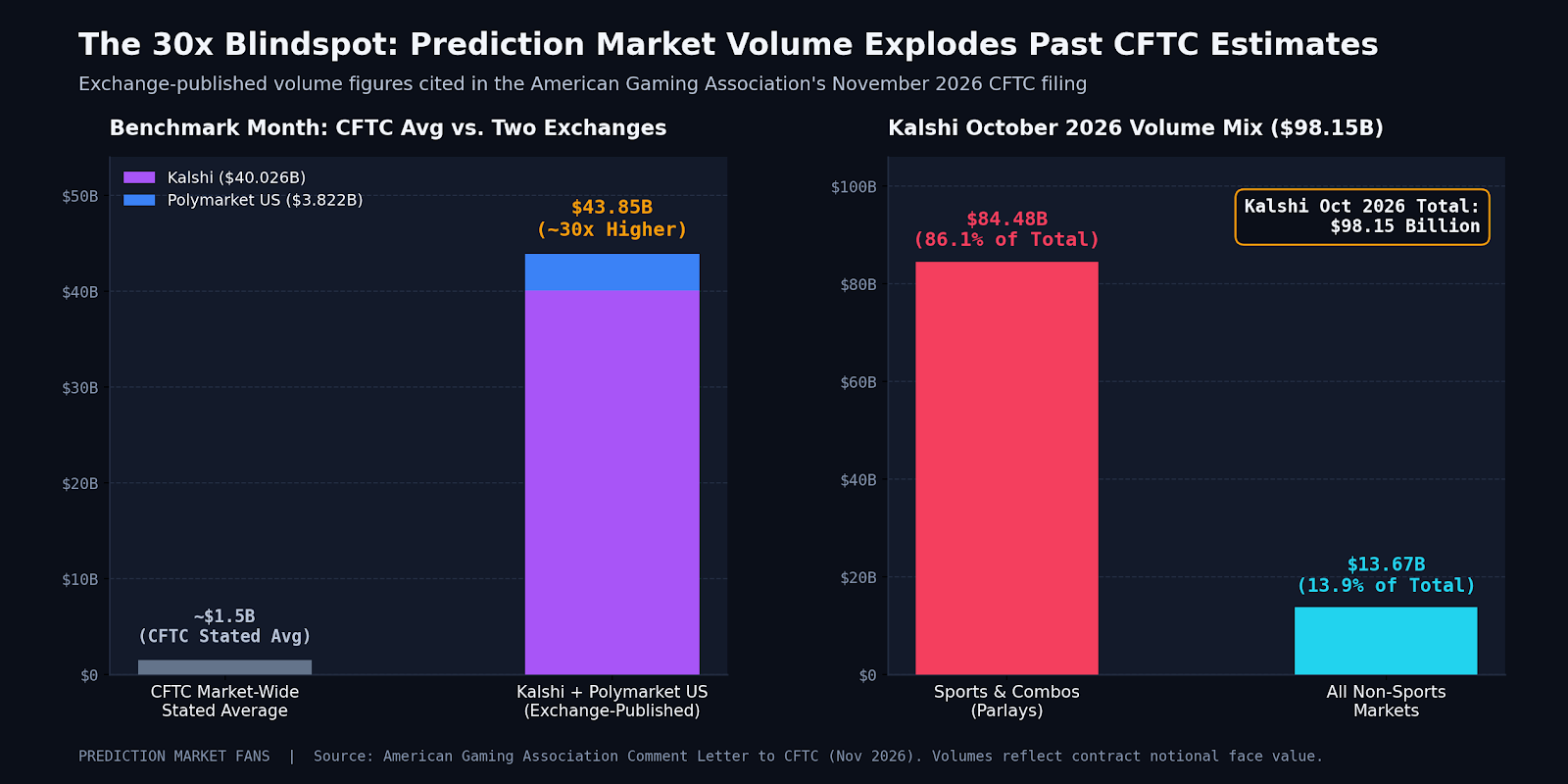
That 86% figure matters enormously in court and in Congress, because it dismantles the polite fiction that prediction markets are primarily macroeconomic hedging tools where sports are just a small side experiment.
Let's be honest about the numbers. Even accounting for the fact that prediction markets report notional volume at $1.00 contract face value rather than cash staked, sports has completely swallowed the U.S. event-contract market. Independent data from KuCoin News showed that 98.2% of Polymarket US's $13.7 billion 30-day volume in late October 2026 came from sports contracts. Meanwhile, DeFi Rate and Exploding Topics confirm that Kalshi's October surge lifted it to a $40 billion private valuation and an estimated $4 billion annualized revenue run rate, driven heavily by NFL season volume, World Cup momentum, and parlay-style combos.
When 86% to 98% of your regulated U.S. volume is sports and parlays, calling your product a "financial swap" invites fierce skepticism from judges, state lawmakers, and the leagues themselves. Even the NFL has publicly argued that states should retain the authority to regulate sports event contracts as gambling.
4. The Other Side of the Coin: Why Prediction Markets Fight So Hard for CFTC Oversight
To be an authority in this space, you cannot just echo the casino lobby's talking points. You have to understand why Kalshi, Coinbase, Andreessen Horowitz, Novig, and the Coalition for Prediction Markets are pouring tens of millions of dollars into defending CFTC jurisdiction, and where their argument actually holds real weight.
Look at the strongest counter-arguments filed in the November 18 CFTC comment docket:
1. Exchange vs. House: A Fundamentally Different Market Structure
Traditional sportsbooks operate as the house. When you win, they lose. Because of that built-in conflict of interest, state-regulated sportsbooks routinely charge 4% to 10% hidden vig, limit or ban sharp winning bettors, and refuse to publish transparent order-book depth. Prediction market exchanges operate as neutral matching engines: buyers trade against sellers, prices reflect live crowd-sourced probabilities, and winners are never kicked off the platform for being too accurate.
2. A 50-State Patchwork Kills Liquidity and Price Discovery
A financial exchange lives and dies by pooled liquidity. If a prediction market has to fence off New Jersey traders from Illinois traders, negotiate 50 separate state gaming licenses, pay 50 different tax regimes, and abide by 50 conflicting lists of permitted events, the national order book shatters. As supporters argued in Forbes, fragmenting prediction markets across 50 state silos destroys the very price discovery that makes event contracts valuable as real-time economic and forecasting tools.
3. The CFTC's Self-Regulatory Architecture Scales Differently Than Casinos
Critics of the AGA's "636 vs. 8,400" comparison point out that federal derivatives oversight has never relied on an army of federal inspectors standing on trading floors. The CFTC oversees multi-trillion-dollar exchanges like the CME Group using a principles-based, self-regulatory model: exchanges (DCMs) and clearinghouses must maintain automated market surveillance, real-time trade reporting, segregated customer funds, and enforcement referrals under strict federal Core Principles, backed by the National Futures Association (NFA) and DOJ criminal prosecution. For example, when an insider-trading scheme surfaced on event contracts in early 2026, it was federal surveillance and DOJ prosecutors, not a state casino commission, that brought the first-ever event-contract insider-trading indictment.
4. Incumbent Protection Is Real
Let's not pretend the American Gaming Association is acting out of pure charity. Its members include the largest commercial casino and sportsbook operators in America, who spent billions securing state-by-state sports betting licenses and paying hefty state revenue taxes. Watching Kalshi and Polymarket US enter all 50 states overnight under a single federal license, offering tighter pricing and parlay combos in non-sports-betting states like California and Texas, is an existential competitive threat to legacy sportsbooks.
Both things can be true at the same time: the AGA is protecting its members' regulated moat, and its point about a 636-person federal agency struggling to police $100 billion a month in retail sports wagering is genuinely hard to dismiss.
5. The Federal Circuit Split: Why This Fight Is Headed Straight to the Supreme Court
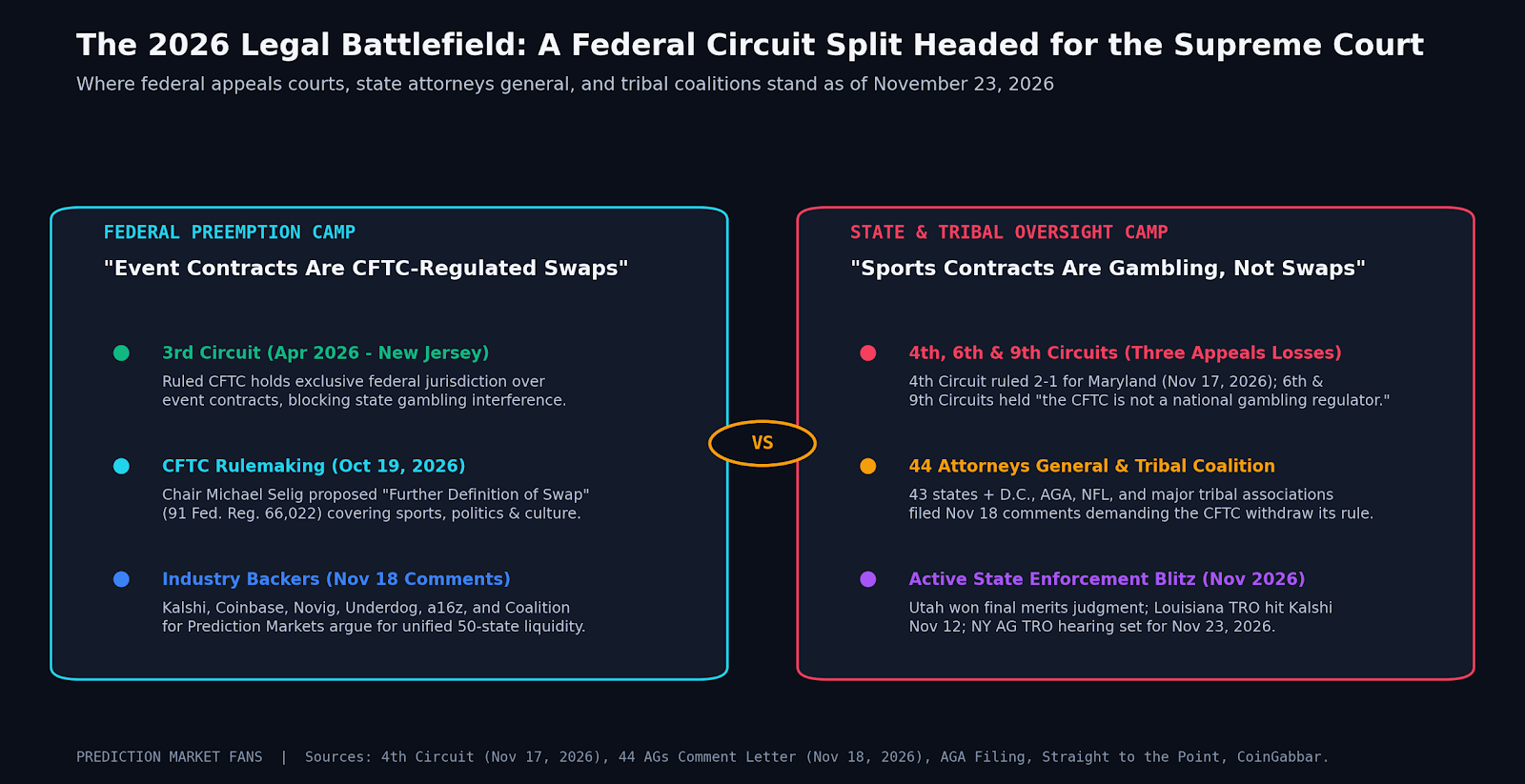
While the CFTC reviews its 263 public comments, federal judges are not waiting around. As of November 23, 2026, the legal map has splintered into a textbook federal circuit split that practically guarantees U.S. Supreme Court intervention.
Here is where the scoreboard stands right now:
Third Circuit (April 2026, New Jersey: Win for Kalshi): A federal appeals panel ruled that the CFTC holds exclusive jurisdiction over event contracts traded on regulated exchanges, blocking New Jersey gaming regulators from enforcing state gambling laws against Kalshi.
Sixth and Ninth Circuits (2026: Losses for Kalshi): Unanimous appellate panels rejected the argument that sports betting contracts qualify as CFTC-regulated swaps, with Circuit Judge Ryan Nelson writing bluntly that "the CFTC is not a national gambling regulator".
Fourth Circuit (November 17, 2026, Maryland: 2-1 Loss for Kalshi): Just six days ago, the Fourth Circuit denied Kalshi's appeal to block Maryland gaming regulators from pursuing enforcement. Notably, the two judges in the majority split on why Kalshi lost: Judge Stephanie Thacker doubted sports contracts qualify as financial swaps at all, while Judge Roger Gregory argued that even if they did, federal law would not override Maryland's traditional state police power over gambling.
The State Enforcement Blitz (November 2026): Emboldened by three appellate wins out of four, individual states are moving fast. Utah secured a final federal merits judgment holding that the Commodity Exchange Act does not preempt Utah gambling laws. Louisiana hit Kalshi with a temporary restraining order on November 12, forcing geo-blocks in the state. And New York Attorney General Letitia James, backed by two former CFTC chief trial attorneys on her legal team, heads into a state-court TRO hearing against Kalshi on Monday, November 23, 2026. Meanwhile, Polymarket US agreed in late October to wind down sports contracts in Michigan by November 25, 2026.
Even if Chairman Selig finalizes the CFTC's "Further Definition of Swap" rule in early 2027, the 44 Attorneys General have already telegraphed their next move: they will challenge the rule immediately under the Major Questions Doctrine, arguing that Congress never clearly authorized a 636-person commodities agency to nationalize sports gambling and erase decades of state and tribal sovereignty.
6. What This Means for Traders and the Future of Prediction Markets
For readers of Prediction Market Fans, the takeaway is not to panic; it is to read the chessboard clearly before placing long-dated capital.
Expect state-by-state geo-fencing turbulence in sports markets through 2027. Until the Supreme Court settles the circuit split or Congress passes comprehensive federal legislation, sports contracts on US-regulated exchanges face rolling state TROs and settlement wind-downs (as seen in Louisiana, Michigan, Utah, and potentially New York). Avoid locking up large capital in long-dated sports futures on US venues without checking your state's current litigation status.
Watch for a sharp legal split between sports and non-sports contracts. Notice the fallback offer buried inside the 44 Attorneys General's letter: they suggested the CFTC could regulate event contracts with clear financial or economic consequences while carving out sports and casino-style contracts for states and tribes. If a compromise emerges in Congress or the courts, macro, elections, weather, and finance contracts could emerge permanently safe under CFTC oversight, while sports combos face a much tougher fight.
Expect heavier consumer-protection tools on prediction markets. To blunt the AGA and AGs' sharpest public-safety attacks, expect Kalshi, Polymarket US, and newer entrants to aggressively roll out stricter 21+ age gates, mandatory deposit limits, cooling-off timers, and centralized self-exclusion tools, narrowing the gap with state-regulated sportsbooks.
This is why Polymarket's November overhaul makes total sense. Remember how Polymarket just slashed international non-sports fees by up to 86% while tightening US compliance? With 86% to 98% of US volume tied to contested sports contracts, every major platform knows it must fortify its non-sports breadth and institutional compliance posture before the Supreme Court rules.
The American Gaming Association's "636 vs. 8,400" argument will be quoted in courtrooms, Senate hearings, and cable news segments for the next twelve months. Whether prediction markets emerge as America's unified 50-state financial exchange or get forced back inside state borders will come down to one question: can a nimble federal derivatives regulator prove it can police a $100-billion-a-month sports juggernaut before the Supreme Court decides it was never supposed to try?
Editorial note: Informational and educational commentary only — not financial or trading advice. Prediction markets involve risk of loss.

Editor-in-Chief
Ezekiel Njuguna is the Editor-in-Chief of Predictions Market Fans, where he helps make probabilistic thinking clear and practical for readers. With a strong focus on quantitative research and market mechanics, he leads the site’s technical guides, including a detailed breakdown of Kalshi Combos. His writing connects economic theory with real-world trading strategy, including practical discussions of how yield-bearing tools can support active bankroll management.
The Weekly Signal
Every Friday — the week's sharpest prediction market analysis, forecasting insights, and data-driven commentary. No noise.