Polymarket Will Never Be the Same: Inside the November 2026 Overhaul Reshaping Prediction Markets
If you have been trading event contracts over the past two weeks, you have probably felt the ground shifting beneath Polymarket.
Look at any single headline in isolation and it is easy to shrug it off as routine startup housekeeping. A round of layoffs here. A faster order-matching engine there. A tweak to sports cancellation rules, a revised fee schedule, and a few noisy threads on X about account restrictions. Platforms ship updates every week.
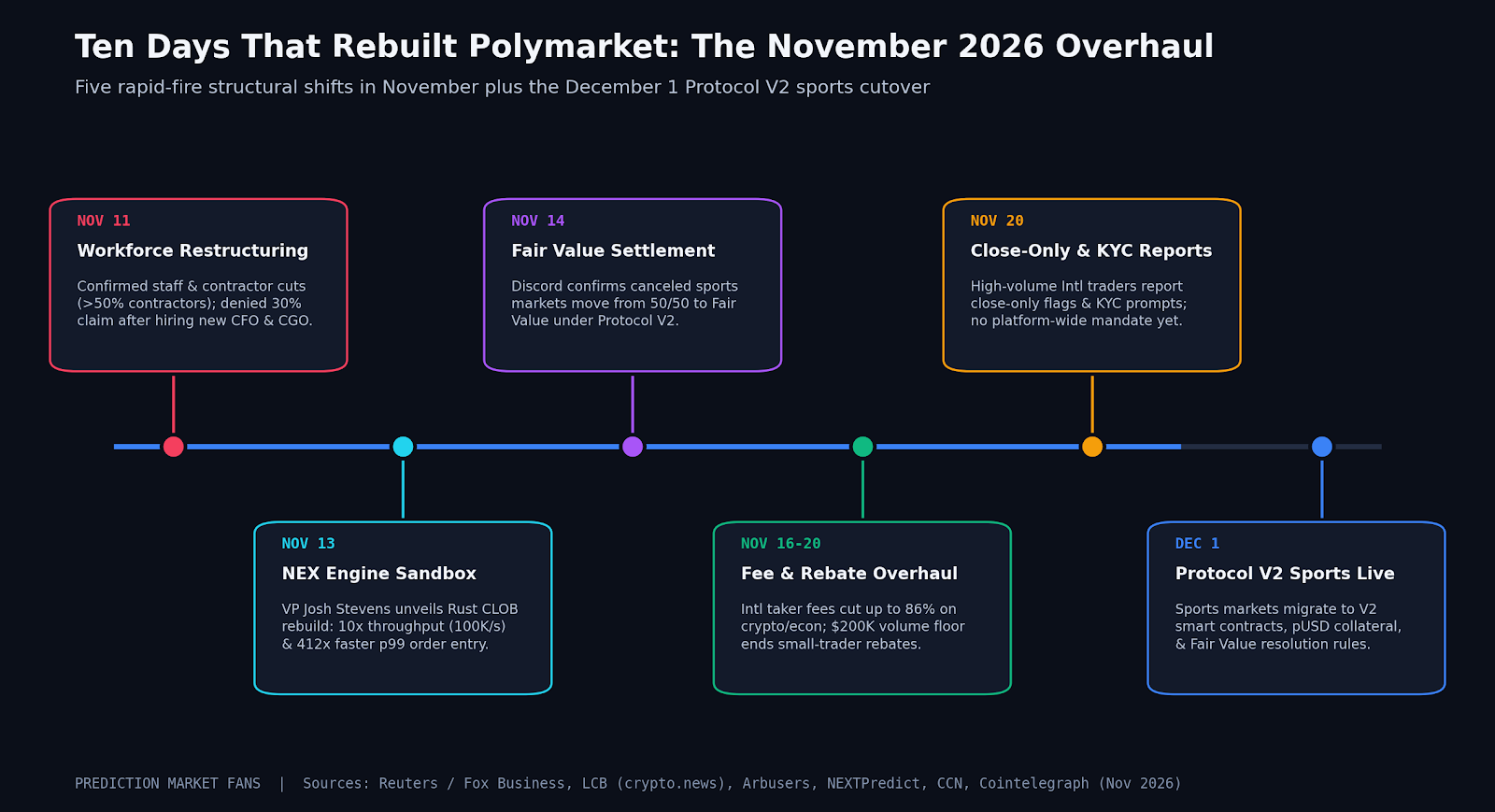
Put all five developments on a single calendar, however, and a completely different picture snaps into focus. Between November 11 and November 20, 2026, Polymarket executed the most aggressive operational, technical, and economic restructuring in its history. Every move points toward one unmistakable reality: the scrappy, crypto-native prediction market that broke into mainstream culture during the 2024 election cycle is gone. In its place, Polymarket is rebuilding itself into an institutional-grade exchange designed to survive regulatory pressure, close the massive volume gap with Kalshi, and unify its split US and international footprint.
For everyday traders, market makers, and sharp bettors, this is not background corporate drama. It directly changes your execution speed, your fee drag, your rebate math, your sports hedging risk, and even your account access. Here is the complete, data-backed breakdown of what just happened at Polymarket, why it is happening right now, and what it means for how you trade heading into 2027.
1. November 11: The Layoffs and Executive Reset Behind the Curtain
The first public tremor hit on November 11, 2026, when Reuters, Front Office Sports, and Fox Business reported that Polymarket had cut both full-time employees and contractors as part of a broad internal reorganization.
The news leaked after an internal termination email sent to contractors circulated on X. According to Reuters, the message stated that agreements were ending effective November 4, 2026 as part of a company-wide reduction in force. Rumors quickly spread that Polymarket had slashed 30% of its headcount. Polymarket pushed back publicly, calling the 30% figure inaccurate, though the company declined to disclose the exact share of staff let go. Sources familiar with the restructuring told Fox Business and iGamingToday that more than half of the departures were contractors, with marketing, customer experience, and engineering teams absorbing the biggest impact.
Why would a company valued at roughly $21 billion and backed by up to $2 billion from Intercontinental Exchange (ICE), the parent company of the New York Stock Exchange, suddenly trim staff?
Look at the C-suite hires that preceded the cuts. In September 2026, Polymarket appointed Warren Jenson as its first chief financial officer, following the earlier addition of former Uber executive Travis VanderZanden as chief growth officer. When a hyper-growth crypto startup brings in a seasoned public-company CFO and an operational scaling executive, the first order of business is always the same: audit every contractor spend, strip out overlapping teams, and run the balance sheet like an exchange preparing for institutional scrutiny or an eventual IPO.
A company spokesperson framed the cuts as reorganizing for its next phase of growth while continuing to hire selectively. Translated from corporate speak, Polymarket is trading loose startup headcount for tighter operating margins and specialized exchange engineering.
2. November 13: NEX, the Rust Trading Engine Built to Replace the Legacy CLOB
Two days after the layoff headlines, Polymarket gave traders the clearest proof yet of where its engineering resources are actually going. On November 13, VP of Engineering for DeFi Josh Stevens (@devjoshstevens) announced the public sandbox for NEX, a ground-up Rust rewrite of Polymarket's Central Limit Order Book (CLOB).
If you traded through Polymarket's growing pains in 2026, including a painful nine-hour API outage in early September, you know why a total rebuild became non-negotiable. Polymarket's legacy CLOB was never architected for institutional high-frequency volume or the demands of Polymarket Perps, which the platform launched in 2026. Rather than patching legacy bottlenecks, Stevens's team started building NEX in August and began running it in shadow mode alongside the live exchange, mirroring every real production order for a planned four-week trial ahead of a tentative mid-December 2026 rollout.
The internal exchange benchmarks shared by Stevens and reported by LCB and crypto.news are staggering:
Sustained throughput jumps 10x: From 10,000 commands per second on the legacy CLOB to 100,000 commands per second on NEX, with burst capacity rising from 15,000 to 150,000 commands per second. The engineering roadmap targets 200,000 to 250,000 commands per second after initial optimizations, and eventually up to one million commands per second.
99th-percentile order placement drops 412x: From 1.55 seconds (1,550 milliseconds) down to 3.76 milliseconds.
Individual order cancellation drops 196x: From 627.92 milliseconds down to 3.20 milliseconds.
Cancel-all execution becomes synchronous and up to 650x faster: On the old engine, a cancel-all request returned an acknowledgement while cancellations still ran in the background for 640 milliseconds to 2.04 seconds, exposing market makers to toxic fills. NEX confirms only after every order is actually wiped, completing at 3.14 milliseconds at the 99th percentile.
WebSocket order-book updates drop 890x: From 44.5 to 88.1 milliseconds down to 0.099 milliseconds, dramatically reducing stale quotes.
Engine recovery time shrinks 20x: Startup time falls from five minutes to 15 seconds.
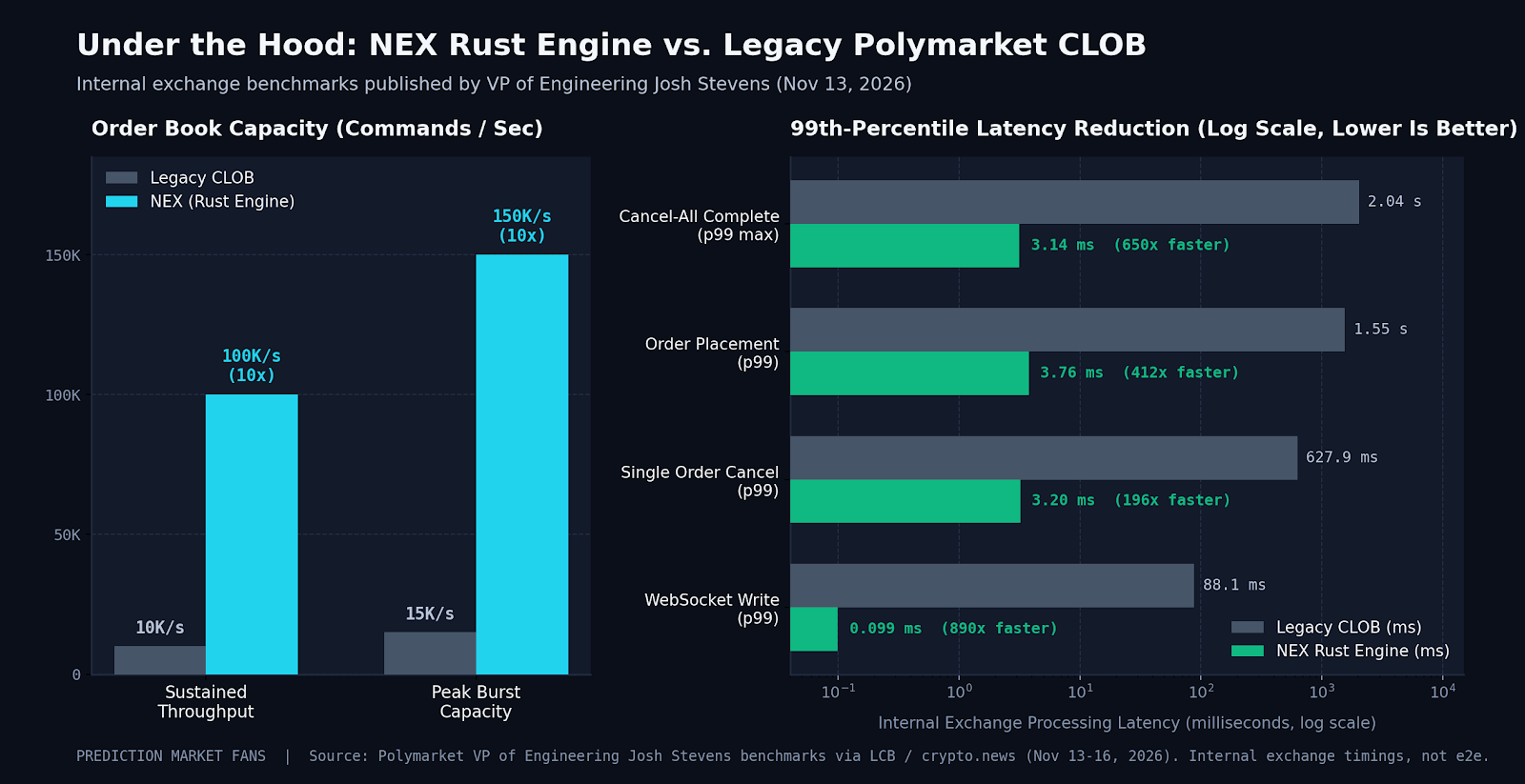
Stevens carefully noted that these are internal exchange timings rather than end-to-end network latencies. Even with that caveat, the strategic impact is massive. Tight spreads in prediction markets do not come from retail enthusiasm alone; they come from professional market makers who feel safe quoting heavy size without getting picked off during breaking news or live sports plays. By slashing cancel-all latency from two seconds to three milliseconds and preserving API compatibility so bots do not break during migration, NEX directly removes the biggest structural tax on Polymarket International's liquidity.
3. November 14 & December 1: Fair Value Settlement and the Protocol V2 Sports Migration
One day after NEX hit the sandbox, a quieter but equally consequential shift surfaced in Polymarket's official Discord and spread across trading circles on X on November 14. According to staff messages documented by Arbusers, Polymarket is replacing its longstanding 50/50 settlement rule for canceled, abandoned, or postponed sporting events with Fair Value settlement.
The upgrade is tied directly to the migration of sports markets onto Protocol V2, scheduled for December 1, 2026. (Markets already listed prior to the cutover will still resolve under their original rules.)
To understand why sharp traders are paying close attention, consider how the old 50/50 rule distorted live sports markets. Suppose a tennis match or football game is heavily lopsided, with the favorite trading at 88 cents, and suddenly rain, injury, or a crowd incident forces an abandonment with no official result. Under the legacy rule, the market snapped to a 50/50 split (or a draw where applicable). That created a predictable, lucrative edge for fast snipers who monitored weather delays and stadium feeds, buying the underdog at 12 cents or selling the favorite at 85 cents the instant a cancellation looked likely. One trader who shared the Discord update publicly noted making more than $10,000 sniping canceled games off slower bots and market makers.
Under Fair Value settlement, Polymarket will resolve unfinished sports markets using recent trading data on Polymarket and other relevant information known to the market at the time of settlement. A team cruising toward a win when a game is abandoned should no longer be flattened into a coin flip.
Just as important is the smart-contract foundation making this possible. As detailed by Cointelegraph via TradingView, Protocol V2 replaces Polymarket's older Conditional Tokens Framework with a unified architecture:
Single collateral standard: All V2 markets settle in Polymarket USD (pUSD), a collateral token backed 1:1 by Circle's USDC, paving the way for future cross-chain transfers of collateral and positions.
Upgradeable contracts and heavy security: Audited by Cantina, Quantstamp, and Zellic, formally verified by Certora, and backed by a bug bounty of up to $5 million.
OracleAggregator: Instead of relying exclusively on one dispute mechanism, V2 connects to multiple oracle sources, including UMA and Chainlink, to reduce settlement disputes.
A critical warning for cross-platform hedgers: Fair Value settlement closes the 50/50 sniper exploit, but it does not eliminate cross-venue basis risk. Traditional sportsbooks almost always void bets and refund stakes when a match is abandoned. A 50/50 settlement never matched a sportsbook void, and Fair Value settlement will not match a void either. If you arbitrage or hedge between Polymarket and traditional bookmakers, you still carry settlement mismatch risk on unfinished games and must price that into your edge.
4. November 16 to 20: The Fee Cut and Rebate Overhaul That Targets Kalshi
If NEX is Polymarket's engine upgrade, the fee and rebate overhaul announced on November 16 and 17, which went live on November 20, 2026 at 23:59 UTC, is its commercial weapon.
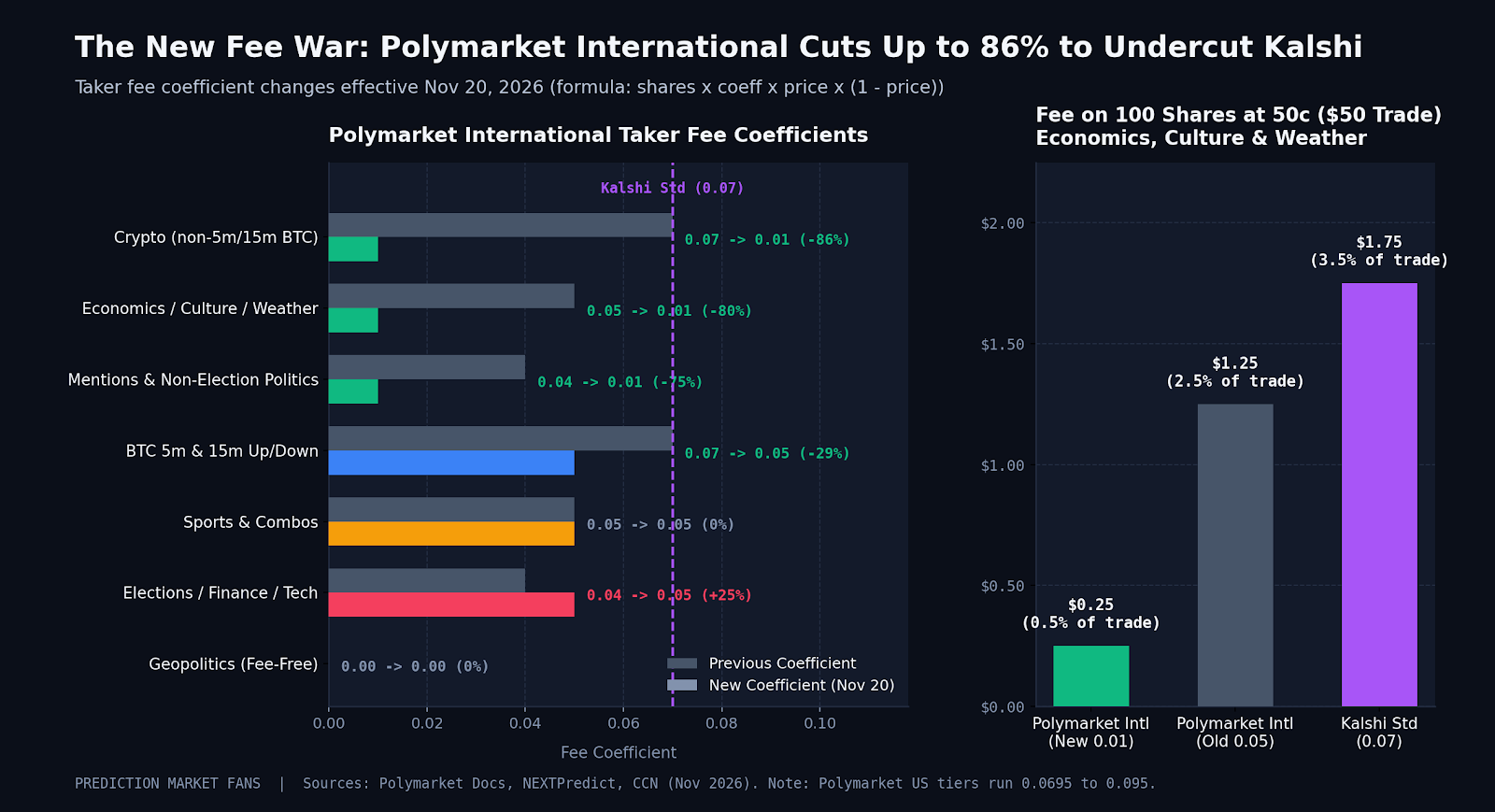
Polymarket kept its core taker fee formula intact: shares x coefficient x price x (1 - price). What changed dramatically are the coefficients on Polymarket International (polymarket.com), as documented in full by NEXTPredict and CCN:
Non-5m/15m Crypto markets: Slashed 86%, from
0.07down to0.01.Economics, Culture, and Weather: Cut 80%, from
0.05down to0.01.Mentions and Non-Election Politics: Cut 75%, from
0.04down to0.01.5-minute and 15-minute Bitcoin Up/Down markets: Reduced 29%, from
0.07to0.05.Sports, Combos, and General markets: Unchanged at
0.05.Geopolitics: Remains completely fee-free (
0.00).Elections, Finance, and Tech: Increased 25%, rising from
0.04to0.05.
Put that into real trader dollars. On a 100-share buy at 50 cents ($50 trade) in an economics, culture, or weather market, a taker previously paid $1.25 (2.5% of trade value). Starting November 20, that same trade costs just $0.25 (0.5%). On Kalshi, which opened to international traders in October 2025 and charges a standard 0.07 taker coefficient, that exact same $50 trade costs $1.75. Polymarket International is now seven times cheaper than Kalshi in those categories.
There is a sharp catch, however, and it reveals exactly who Polymarket is optimizing for. Alongside the fee cuts, Polymarket overhauled its taker and maker rebate ladders:
Small-trader taker rebates are gone: Polymarket eliminated its Bronze and Silver tiers and ended one-time level-up bonuses. You now need at least $200,000 in 30-day weighted volume (calculated as
shares x price x (1 - price), which requires significantly more than $200,000 in raw notional dollars) just to enter Gold (10% rebate). At the top end, a new Onyx tier returns 60% of taker fees to whales clearing $75 million in 30-day weighted volume.Market makers face a major squeeze in cut categories: Makers moved from daily category pools (previously 20% to 25% of taker fees) to volume-tiered payouts starting at $200,000, returning 3% to 15% of the taker fees their fills generate. Combine a smaller taker fee pool with a lower rebate share, and a maker filling 100 shares at 50 cents in an economics or weather market sees their rebate drop from roughly $0.31 to about $0.04, a cut of nearly 90%.
Meanwhile, Polymarket US operates on a completely different price list. On November 14, the CFTC-regulated US exchange shifted to volume-tiered fees ranging from 0.0695 to 0.095, making it more expensive than both Polymarket International and Kalshi's 0.07 rate for retail accounts trading under $250,000 per month. Outside the US, Polymarket is waging an aggressive price war to win retail takers and whale volume; inside the US, it is still digesting the higher compliance overhead of a federally regulated exchange.
5. November 20: Close-Only Mode, KYC Reports, and the Regulatory Squeeze
On the very day the new fee schedule went live, a more sensitive story began rippling through the Polymarket International community. High-volume traders including @Euanker and @pumposhi_fun publicly reported on November 20 that their accounts had been placed in close-only mode, preventing new trades, alongside reports of users being prompted to complete Know Your Customer (KYC) identity verification to restore full trading access.
It is important to separate confirmed facts from community panic. As of November 23, 2026, Polymarket has not announced a platform-wide mandatory KYC rollout for all international users. Earlier in 2026, when similar rumors broke following a report in The Information, VP of Engineering Josh Stevens clarified that mandatory KYC applied strictly to an early beta product rather than all of polymarket.com.
At the same time, pretending nothing has changed on compliance would be naive. Throughout 2026, Polymarket's international compliance perimeter has tightened dramatically:
Expanding close-only map: As of November 2026, Polymarket fully blocks seven OFAC-sanctioned territories and places 36 countries plus four Canadian provinces in close-only mode on both web and API, including the US, UK, France, Germany, Italy, Australia, Brazil, Singapore, and Thailand (AirdropAlert).
Aggressive VPN and anomaly enforcement: Since May 2026, Polymarket has ramped up blocking known VPN IP ranges and flagging accounts suspected of bypassing geoblocks, pushing flagged wallets into close-only mode or identity review (Coinperps).
Escalating federal and state scrutiny: The pressure is coming from every direction. In May 2026, the US House Oversight Committee requested Polymarket's KYC and geoblocking records going back to January 2024. The CFTC opened an investigation into whether American users were still accessing the international platform, New York sued Polymarket over gambling licensing, and a coalition of 40 state attorneys general signed an amicus brief urging the Supreme Court to allow states to regulate prediction markets (Forbes).
Put simply, even without a blanket international KYC mandate, the era of frictionless, unmonitored high-volume trading from restricted jurisdictions or sloppy VPN setups is over. Polymarket has too much at stake, including its $21 billion valuation, its NYSE-owner backing, and its CFTC-regulated US exchange, to let compliance gaps derail the business.
6. The Real Catalyst: Kalshi's Massive Volume Lead
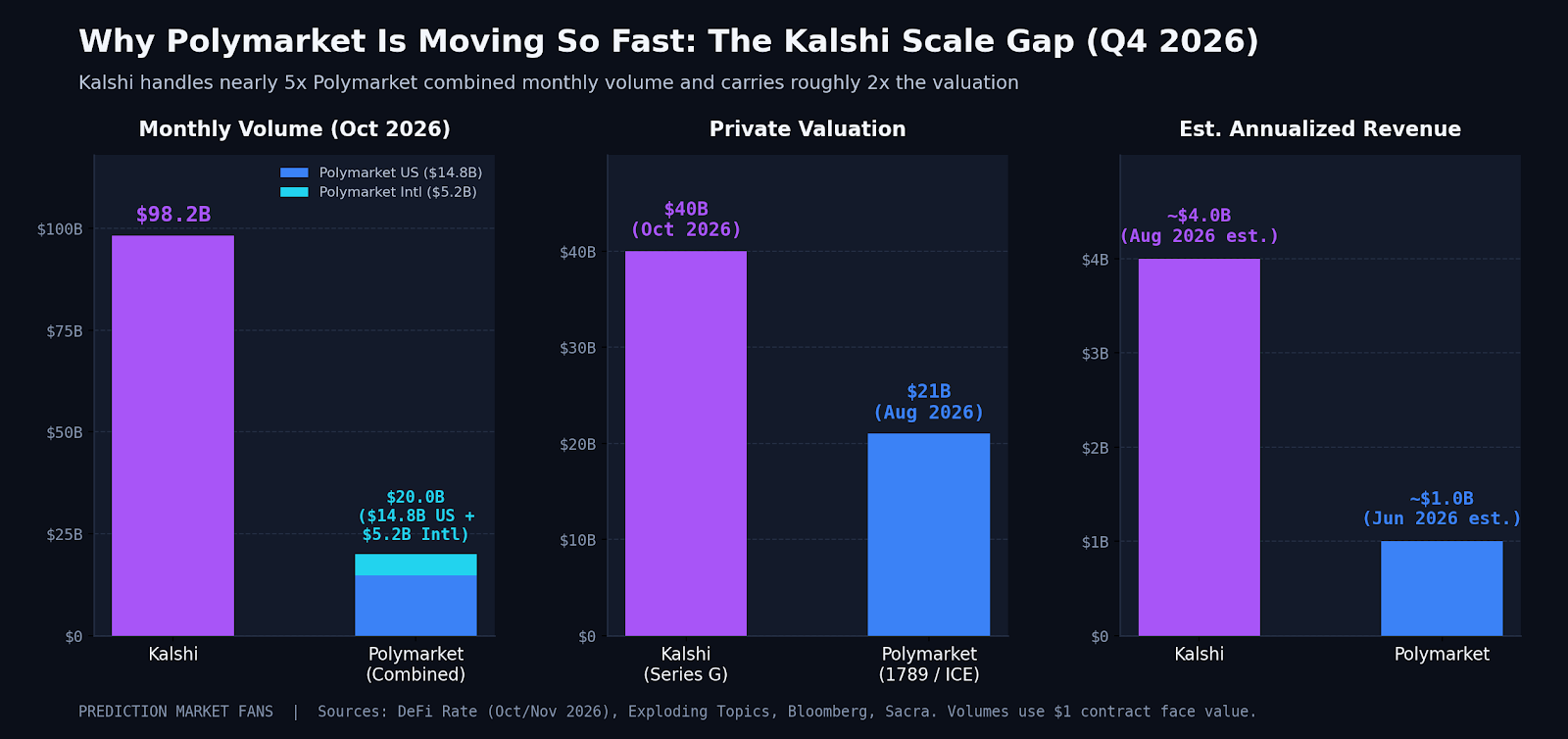
Strip away the technical jargon, and one chart explains the urgency behind every single move Polymarket made in November 2026.
Kalshi has pulled far ahead in raw scale.
According to DeFi Rate volume data compiled by Exploding Topics and Smartkarma, Kalshi traded $98.2 billion in October 2026 alone, capturing roughly 81% of volume across the eight tracked US prediction market exchanges (and 74% of broader US share in Smartkarma's breakdown). During that same window, Polymarket US traded $14.8 billion, while Polymarket International processed $5.2 billion in the 30 days through November 2.
Combined, Polymarket's two exchanges handled roughly $20.0 billion, meaning Kalshi is currently moving nearly five times Polymarket's combined monthly volume. The gap extends to capital and revenue as well: Kalshi raised its Series G in October 2026 at a $40 billion valuation on an estimated $4 billion annualized revenue run rate, roughly double Polymarket's $21 billion valuation and quadruple Sacra's mid-2026 estimate of Polymarket's $1 billion annualized revenue.
Even more telling is where that volume lives. Prediction markets are no longer election-year novelties. Pew Research Center data shows that sports accounted for 78.3% of Kalshi's volume and 82.4% of Polymarket's volume by July 2026, and sports surged to 98.2% of Polymarket US's $13.7 billion volume in late October (KuCoin).
Now every November move locks together like clockwork:
Why cut staff and bring in a veteran CFO? To run lean and deploy capital where it actually wins volume against a $40 billion rival.
Why build NEX in Rust? Because live sports and perpetual contracts demand millisecond execution and 100,000+ commands per second; a two-second cancel lag kills institutional liquidity.
Why switch canceled sports to Fair Value on December 1? Because sports now drive the vast majority of volume, and institutional market makers will not quote deep sports books if 50/50 cancellation rules let snipers bleed them dry.
Why slash international fees by up to 86% on non-sports categories? Because Kalshi expanded internationally and just had to pause certain mention markets under CFTC scrutiny; Polymarket is using ultra-low
0.01fees to lock down global non-sports breadth while keeping sports at0.05to fund operations.Why tighten close-only and KYC enforcement? Because Polymarket cannot grow Polymarket US, defend against 40 state attorneys general, and keep institutional partners like ICE comfortable if its international platform looks like a compliance leak.
7. How This Overhaul Changes the Way You Trade
For Prediction Market Fans readers, strategy matters more than headlines. Here is how to adapt your trading playbook right now:
If you are a retail taker outside the US: Economics, culture, weather, mentions, and non-short-term crypto just became dramatically cheaper to trade on Polymarket International (0.5% effective fee at 50 cents). You lost small-account taker rebates, but in those cut categories, the 75% to 86% upfront fee drop leaves you well ahead. Conversely, if you trade elections, finance, or tech, your costs just rose 25% with no small-tier rebate to soften the blow.
If you are a small or mid-sized market maker: Re-run your spreadsheets immediately. If you sit below $200,000 in 30-day weighted volume, your maker rebates are now zero. Even above $200,000, rebates in the
0.01categories shrank by nearly 90%. Your edge must now come from genuine bid-ask spread capture and sharper pricing, not rebate farming. On the bright side, once NEX goes live in mid-December, 3-millisecond cancel-all times should significantly cut your adverse selection losses.If you trade or hedge live sports: Mark December 1, 2026 on your calendar. Verify whether each sports market you enter is a legacy contract (50/50 cancellation rule) or a Protocol V2 contract (Fair Value settlement). Never assume a Polymarket sports hedge matches a traditional bookmaker's void rule.
If you trade on Polymarket International: Take jurisdiction hygiene seriously. Never trade through VPNs or proxies from restricted regions, keep backup liquidity ready, and understand that close-only mode allows you to exit and withdraw, not add to positions.
Polymarket is growing up fast, and growing up is rarely comfortable for early adopters. The wild-west era of zero fees, loose geoblocks, and 50/50 cancellation exploits is closing. What replaces it will be faster, cleaner, more institutional, and fiercely contested against Kalshi. Traders who adjust to the new fee math, respect Protocol V2 settlement rules, and leverage NEX's speed will find plenty of edge in 2027. Everyone else will wonder why their old playbook stopped working.
Frequently Asked Questions (FAQ)
What is Polymarket's NEX trading engine and when does it launch?
NEX is Polymarket's rebuilt, Rust-based Central Limit Order Book (CLOB) unveiled by VP of Engineering Josh Stevens on November 13, 2026. It increases sustained throughput 10x (from 10,000 to 100,000 commands per second) and slashes 99th-percentile order placement latency from 1.55 seconds to 3.76 milliseconds. After a four-week shadow test, live deployment is tentatively targeted for mid-December 2026.
How does Polymarket's new Fair Value settlement work for canceled sports?
Starting with the Protocol V2 sports migration on December 1, 2026, newly created sports markets that are canceled, abandoned, or delayed without an official result will settle at Fair Value rather than 50/50. Fair Value is determined using Polymarket trade data and relevant market information available at settlement. Existing markets listed before the switch remain on their original rules.
Did Polymarket make KYC mandatory for all International users in November 2026?
No. Although high-volume international traders reported close-only restrictions and KYC prompts around November 20, 2026, Polymarket has not announced a platform-wide mandatory KYC policy for Polymarket International. However, Polymarket enforces strict close-only restrictions across 36 countries and four Canadian provinces, aggressively blocks VPNs, and requires full KYC on its CFTC-regulated Polymarket US app.
Is Polymarket cheaper than Kalshi after the November 20, 2026 fee update?
Outside the United States, yes in most categories. Polymarket International cut its taker fee coefficient to 0.01 on economics, culture, weather, mentions, non-election politics, and most crypto markets, making a $50 coin-flip trade cost $0.25 compared to $1.75 on Kalshi (0.07 coefficient). Inside the United States, however, Polymarket US's tiered schedule (0.0695 to 0.095) is generally more expensive than Kalshi for traders under $250,000 in monthly volume.
Sources & References
Fox Business (Nov 11, 2026): Polymarket lays off employees and contractors amid Kalshi rivalry
iGamingToday (Nov 12, 2026): Polymarket Confirms Job Layoffs as Restructuring Effort Continues
LCB / crypto.news (Nov 16, 2026): Polymarket Opens Nex Sandbox for Faster Trading System
KuCoin News (Sep 29, 2026): Polymarket to Launch New Trading Engine in November
Arbusers (Nov 16, 2026): Polymarket to Move Cancelled Sports Markets to Fair Value
Cointelegraph / TradingView (Oct 6, 2026): Polymarket overhauls smart contracts with new Protocol V2 rollout
NEXTPredict (Nov 18, 2026): Polymarket cuts fees abroad, helping takers and squeezing makers
CCN (Nov 18, 2026): Polymarket Cuts Crypto Fees, Ends Small Trader Rebates
CoinMarketCap Academy (Nov 2026): Polymarket Says KYC Applies Only to New Beta Product, Not Existing Platform
AirdropAlert (Nov 8, 2026): Polymarket Restricted Countries: Full List (November 2026)
Coinperps (Oct 27, 2026): Polymarket Restricted Countries and Where It Is Banned
Forbes (Oct 29, 2026): Polymarket 'Fully Reimbursing' Users After Halting International Trading
Exploding Topics / DeFi Rate (Nov 4, 2026): Kalshi vs Polymarket: Volume, Revenue and Valuation (November 2026)
Smartkarma (Nov 23, 2026): Kalshi At 74% Of U.S. Prediction Markets
KuCoin News (Oct 28, 2026): Polymarket US Generates $13.7 Billion in Contract-Face-Value Trading, 98.2% From Sports
Editorial note: Informational and educational commentary only — not financial or trading advice. Prediction markets involve risk of loss.

Editor-in-Chief
Ezekiel Njuguna is the Editor-in-Chief of Predictions Market Fans, where he helps make probabilistic thinking clear and practical for readers. With a strong focus on quantitative research and market mechanics, he leads the site’s technical guides, including a detailed breakdown of Kalshi Combos. His writing connects economic theory with real-world trading strategy, including practical discussions of how yield-bearing tools can support active bankroll management.
The Weekly Signal
Every Friday — the week's sharpest prediction market analysis, forecasting insights, and data-driven commentary. No noise.