NY AG Letitia James v. Kalshi: Why Justice Melissa Crane Balked at an Immediate Full Ban (November 23, 2026 Courtroom Breakdown)
Kalshi walked into New York County Supreme Court on Monday, November 23, 2026 staring down what its own lawyers called an existential threat.
Just four days earlier, after the U.S. District Court for the Southern District of New York remanded New York's enforcement lawsuit back to state court and the CFTC failed in a second federal bid to shield the exchange, Kalshi attorney Sean Murphy sent an urgent warning letter to Justice Melissa Crane. Because Kalshi is headquartered in New York and runs roughly $178 billion in annualized trading volume, Murphy argued that granting New York Attorney General Letitia James's full temporary restraining order (TRO) "would likely force the liquidation of all open positions, disrupting markets far beyond this State" and "shut down a federally regulated exchange for every customer, everywhere".
Every trader in the prediction market industry held their breath as the virtual courtroom feed flickered to life.
Yet when the dust settled on Monday afternoon. Justice Crane did not hand Attorney General Letitia James the sweeping, immediate shutdown order she wanted. Instead, the judge voiced blunt skepticism about granting a full TRO without hearing Kalshi's full briefing, openly warned she "might be reversed in a minute," questioned why the national circuit split is not already headed straight to the U.S. Supreme Court, and gave both sides until Monday, November 30 to negotiate targeted safeguards for 18-to-20-year-old New Yorkers.
For readers of Prediction Market Fans, this hearing was a masterclass in where the legal war over prediction markets actually stands. Below is the complete play-by-play of what happened inside Justice Crane's courtroom, why the 18-to-20 age gap became the single biggest vulnerability for Kalshi, why Kalshi refuses to "just get licensed in New York," and a clear legal answer to the question every trader is asking: is a TRO all-or-nothing?
1. How We Got Here: From July's Lawsuit to Monday's High-Stakes Remand
Monday's hearing was the culmination of a year-long collision between New York's strict gambling laws and Kalshi's CFTC-regulated event contracts.
In October 2025, the New York State Gaming Commission issued a cease-and-desist order demanding that Kalshi stop offering unlicensed mobile sports wagering in the state. Kalshi fought back in court, lost its initial bid against the Gaming Commission on July 7, 2026 (NY AG Press Release), and three weeks later, on July 31, 2026, Governor Kathy Hochul and Attorney General Letitia James filed a formal enforcement action against KalshiEX, LLC in New York state court.
To prosecute the case, AG James assembled serious derivatives firepower inside her Investor Protection Bureau, led by Assistant Attorneys General K. Brent Tomer and Alejandra de Urioste, both former CFTC chief trial attorneys who know the Commodity Exchange Act inside and out.
Kalshi initially removed the lawsuit to federal court in the Southern District of New York (1:2026cv06550), triggering months of procedural maneuvering across SDNY and the Second Circuit. On November 19, 2026, the federal court granted New York's motion to remand the case back to New York County Supreme Court. Even Monday's hearing nearly stalled out of the gate over a technicality: during pre-hearing discussion at 16:34 GMT, it emerged that the Attorney General's office had not yet delivered a certified copy of the federal remand order. Once the virtual stream stabilized (despite laptop connectivity glitches that sent observers scrambling to their phones), Justice Melissa Crane wasted zero time cutting to the core of the dispute.
2. The Four Courtroom Exchanges That Changed the Trajectory of the Case
Reading through Daniel Wallach's live courtroom transcript from 16:48 to 17:15 GMT, four exchanges stood out as decisive moments that shaped Kalshi's short-term survival in New York.
Exchange 1: "I might be reversed in a minute" and the Supreme Court Shadow
Early in the argument, Justice Crane confronted the elephant in the room: the rapidly widening federal circuit split over whether sports event contracts are CFTC-regulated swaps or state-regulated gambling.
"It just seems to me that I might be reversed in a minute if I granted the full TRO that you want."
Moments later, Crane went even further, asking aloud: "Why isn't this headed straight to the Supreme Court?" She openly questioned whether a state trial judge should pause and weigh the likelihood of Supreme Court review before dropping a nuclear injunction on a federally regulated exchange.
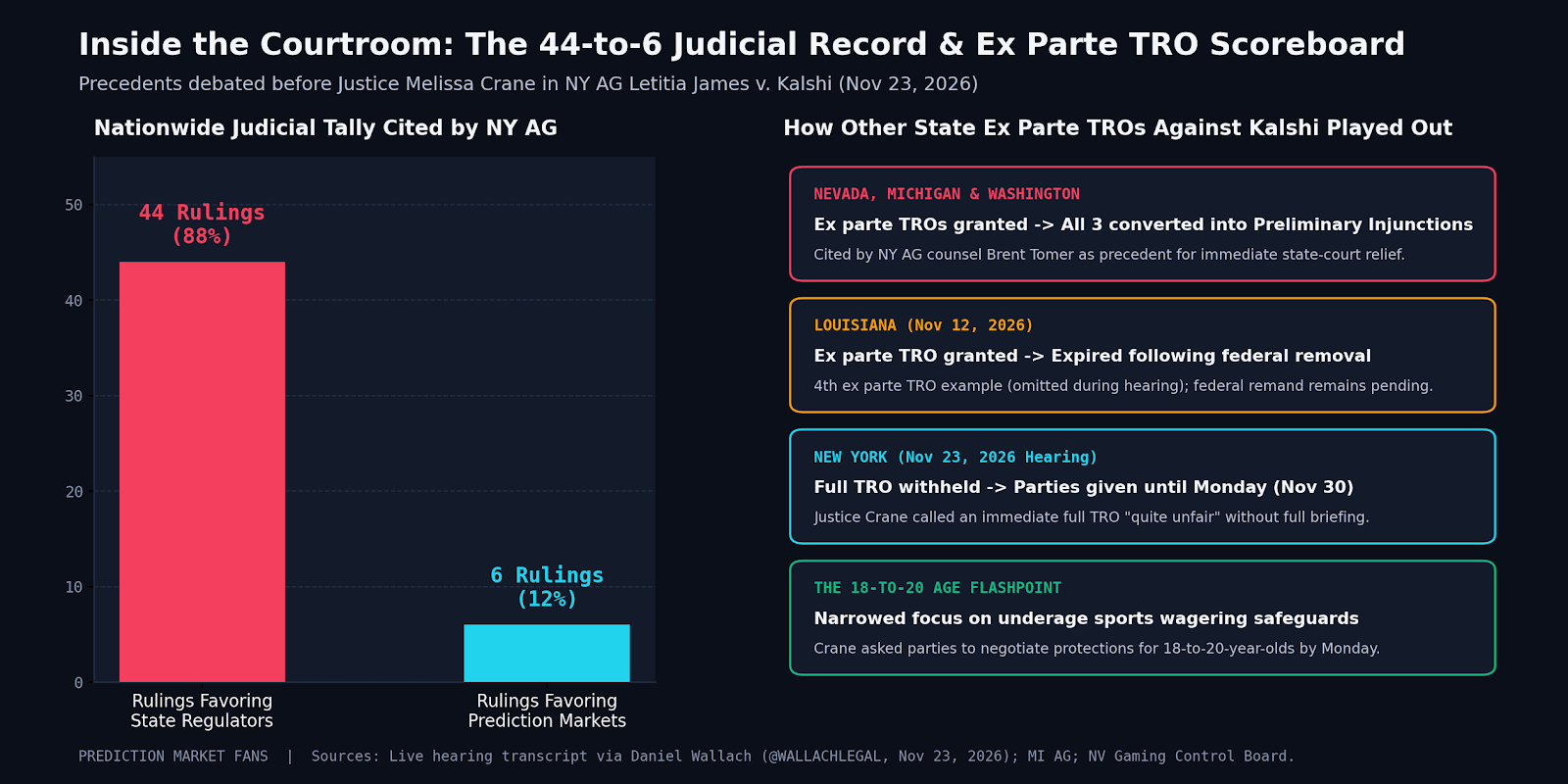
AG counsel Brent Tomer pushed back hard, pointing to the lopsided nationwide judicial scoreboard: 44 rulings favoring state regulators versus just 6 favoring prediction-market operators (a 44-to-6 record tracked extensively by Wallach). When Crane asked why other courts had been willing to issue immediate ex parte TROs against Kalshi, Tomer cited Nevada, Michigan, and Washington, all three of which later converted their TROs into full preliminary injunctions after briefing (leaving out Louisiana, the fourth state to issue an ex parte TRO on November 12, which expired following federal removal).
Exchange 2: "Why Did the NY AG Wait So Long?"
In any emergency TRO request, urgency is everything. If a plaintiff sits on its hands while alleged harm continues, judges routinely deny emergency relief and force the case into a standard preliminary injunction schedule.
Justice Crane pressed Tomer directly on why the Attorney General waited so long to seek an immediate halt to Kalshi's sports contracts if the alleged violations were so severe. Tomer attributed the gap to the months of procedural delays caused by Kalshi's removal to SDNY and litigation in the Second Circuit.
Crane then probed another procedural tension: the NY AG had signaled willingness to accept expedited briefing, which Crane suggested undermined the claim that the court needed to grant an immediate TRO before hearing Kalshi's full written arguments. Calling an immediate full TRO "quite unfair" without hearing Kalshi's side in full, Crane told the AG's team bluntly: "I think this is your shot at the TRO."
Exchange 3: The 18-to-20 Age Flashpoint
If Justice Crane gave Kalshi breathing room on a full platform ban, she showed zero patience for one glaring gap in Kalshi's New York operations: underage sports wagering.
New York law strictly bans anyone under 21 from placing sports wagers, and separately restricts wagers on New York collegiate teams. Kalshi, operating under federal CFTC rules where derivatives accounts generally open at 18, allows 18-to-20-year-olds to trade sports event contracts.
Justice Crane returned to this issue three separate times during the hearing:
She asked Kalshi's counsel directly whether Kalshi would voluntarily stop offering sports event contracts to 18-to-20-year-olds in New York.
She pressed the NY AG on exactly how licensed New York online sportsbooks enforce the 21+ rule and whether users must upload government IDs (Tomer said that was his understanding while noting the technical specifics were not yet in the formal record).
She questioned why an emergency full shutdown was necessary when adults 21 and older can already legally bet on sports in New York through licensed mobile sportsbooks.
By the close of the hearing at 17:15 GMT, Crane had zeroed in on a pragmatic middle ground: she withheld a full TRO and gave both sides until Monday, November 30 to negotiate concrete safeguards protecting 18-to-20-year-olds.
Exchange 4: "Why Not Just Get Licensed for Gambling in New York?"
Perhaps the most revealing moment for everyday observers came at 17:06 GMT, when Justice Crane asked Kalshi's counsel a disarmingly simple question:
"Why not just get licensed for gambling in New York?"
On the surface, it sounds like common sense. DraftKings, FanDuel, BetMGM, and Caesars all hold New York licenses. Why won't Kalshi simply fill out the paperwork and join them?
3. Answering Justice Crane's Question: Why Kalshi Cannot "Just Get Licensed" in New York
To understand why Kalshi would rather spend tens of millions fighting in federal and state courts than apply for a New York mobile sports betting license, look at the raw economics and statutory walls built into New York's gaming regime.
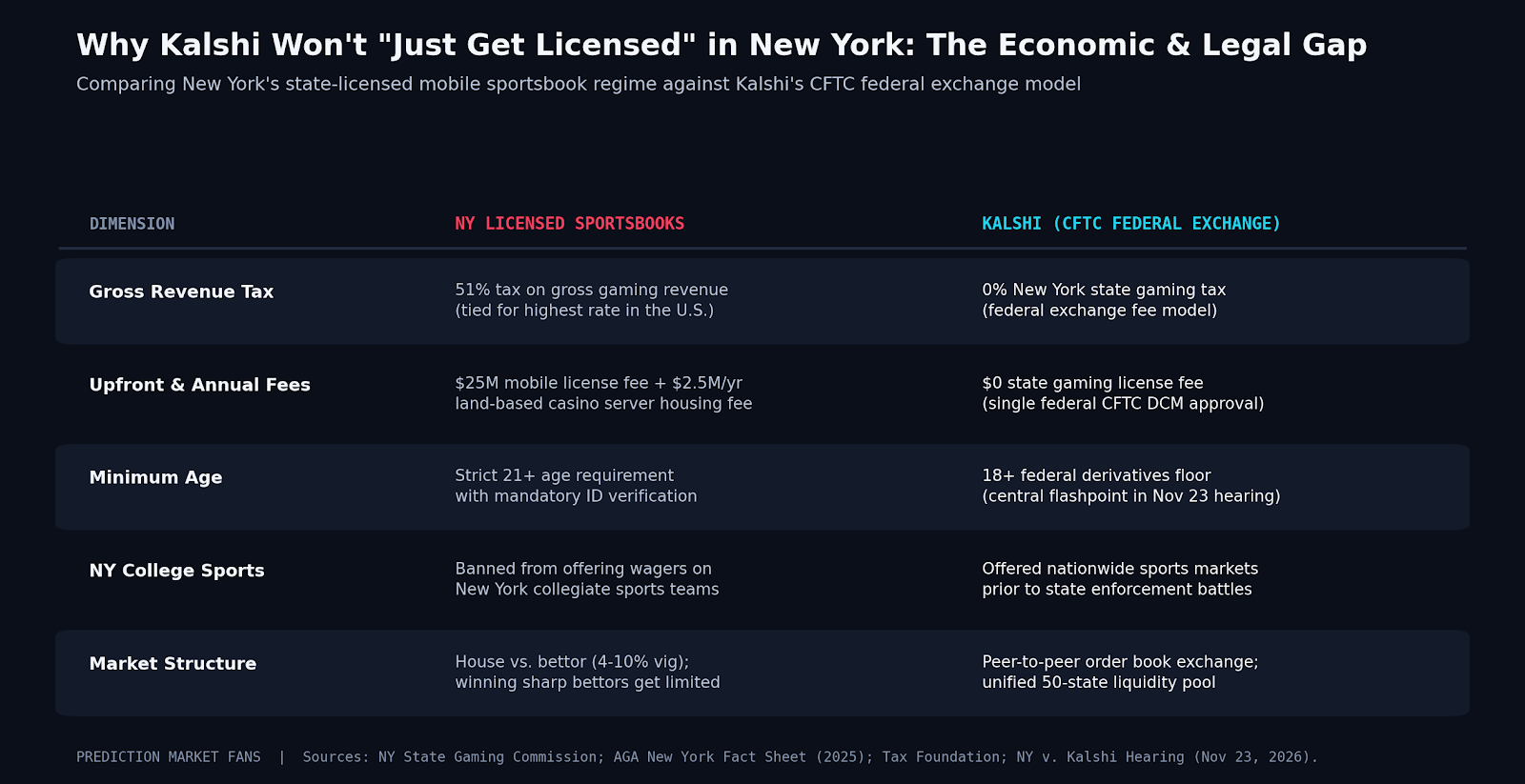
There are four structural reasons Kalshi cannot simply "get a New York gambling license":
The 51% Gross Gaming Revenue Tax Destroys Exchange Economics: New York imposes a 51% tax on mobile sports wagering gross gaming revenue, tied for the highest tax rate in the United States. Traditional sportsbooks survive a 51% tax by charging retail bettors 4% to 10% hidden vig and aggressively limiting winning players. A peer-to-peer exchange like Kalshi earns thin transaction fees on matched volume; handing 51% of revenue to a single state while maintaining low spreads breaks the entire financial model.
$25 Million Upfront Plus $2.5 Million Every Year to a Casino: New York requires mobile sports betting providers to pay a $25 million license fee, plus $2.5 million per year to a licensed land-based commercial casino simply to house servers and equipment, and licenses were awarded through a closed competitive bidding process capped by statute. Kalshi cannot simply walk up to a counter and buy one.
Shattering the National Order Book: State gambling licenses require ring-fenced intrastate pools or strict state-by-state compliance rules, including bans on New York college sports and strict pre-approval of promotional credits. If Kalshi accepts a state gambling license in New York, it concedes the very legal principle keeping its unified 50-state CFTC exchange alive, inviting 49 other states (including non-sports-betting giants like California and Texas) to shut it down or demand their own cut.
Constitutional and Legislative Barriers: As legal analysts noted heading into Monday's hearing, New York's current mobile sports betting statute and Article I, Section 9 of the New York State Constitution do not even contemplate a peer-to-peer derivatives exchange. Getting licensed would require the New York Legislature to rewrite state law from scratch.
4. Question Answered: Is a TRO All-or-Nothing, or Can Justice Crane Issue a Tailored Order?
"Question: is this granted on an all or nothing basis? Meaning, is it either full TRO or dismissed? Can the judge issue a modified order specific to sports contracts?"
The short answer is no: a TRO is definitely not all-or-nothing.
Under New York civil practice (CPLR Article 63), a Supreme Court justice sits in equity and holds wide discretion to craft narrowly tailored interim relief. Justice Crane does not have to choose between shutting down Kalshi nationwide or dismissing Letitia James's lawsuit altogether. Look at the four realistic paths sitting on the table between now and next week:
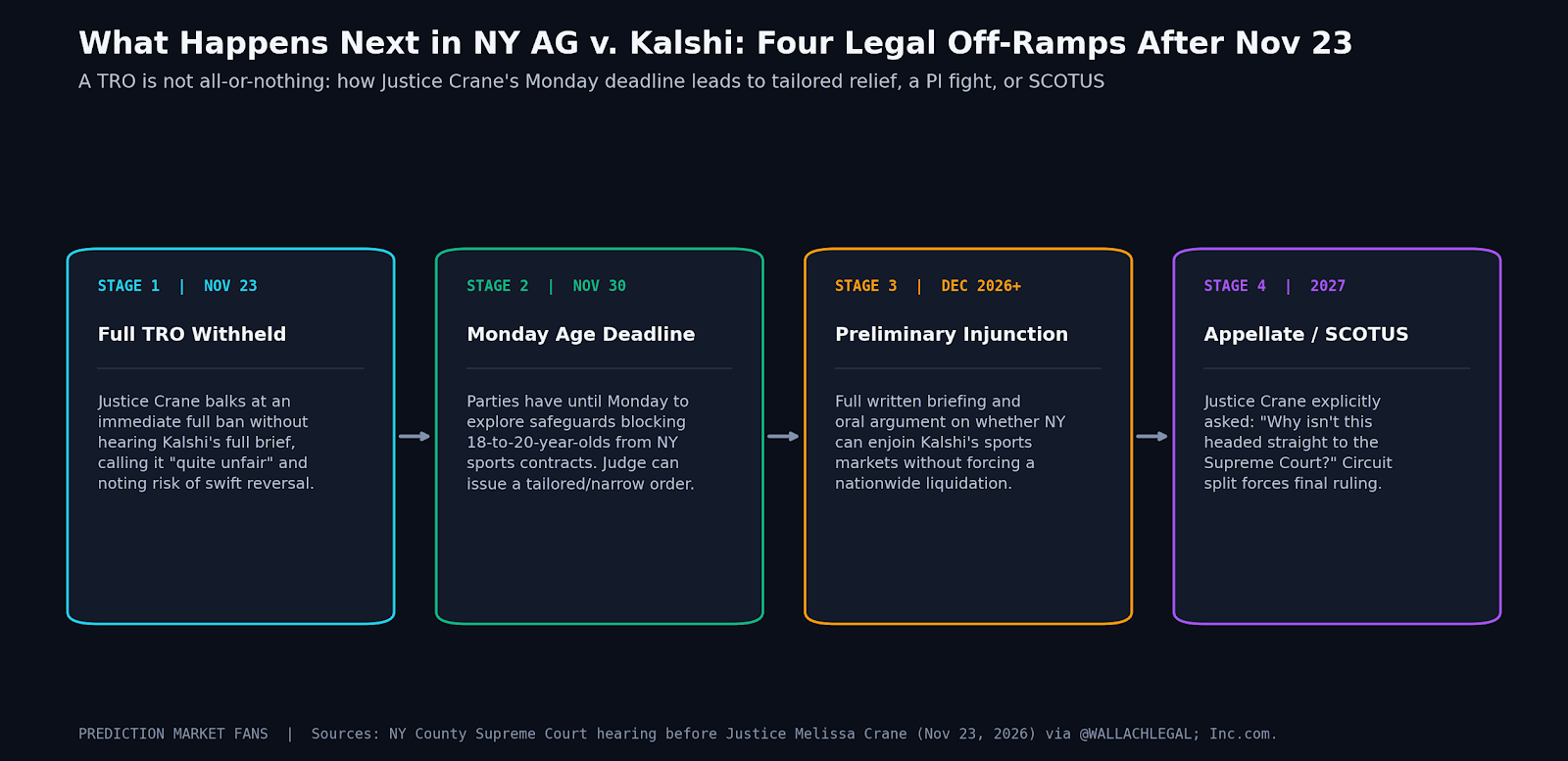
A Narrowly Tailored Consent Order on 18-to-20-Year-Olds (Most Likely Short-Term Outcome): By giving both sides until Monday, November 30 to discuss safeguards for 18-to-20-year-olds, Crane handed Kalshi an obvious olive branch. If Kalshi agrees to implement strict 21+ age gating (and potentially restrict New York college sports markets) for New York residents while the broader case is briefed, Crane has zero reason to issue a disruptive full TRO.
A Modified TRO Limited Strictly to Sports Contracts in New York: Even if the talks break down by Monday, Crane can still issue a tailored order enjoining only New York sports event contracts (or only sports contracts for users aged 18 to 20) while leaving Kalshi's economics, weather, inflation, and political markets untouched and avoiding the nationwide liquidation nightmare Kalshi's lawyers warned about.
Full TRO Denied, Case Advances to Preliminary Injunction (PI): Denying a TRO does not dismiss the lawsuit. As Justice Crane explicitly noted, denying the TRO simply moves the battle to the preliminary injunction stage, where both sides submit full legal briefs and evidentiary records on federal preemption, the Commodity Exchange Act, and New York's gaming statutes. Remember: in Nevada, Michigan, and Washington, the real long-term geo-fencing blocks came at the preliminary injunction stage.
A Stay Pending Appellate or Supreme Court Review: Given Crane's pointed remark about being "reversed in a minute" and asking why the circuit split is not already at the Supreme Court, Kalshi will almost certainly argue at the preliminary injunction stage that the court should stay any sweeping shutdown order until federal appellate courts or SCOTUS settle the national preemption question once and for all.
5. What Traders Should Watch Between Now and Monday, November 30
Monday's hearing proved two things at once. First, Kalshi dodged an immediate, catastrophic shutdown order in its home state. Second, the 18-to-20 age gap is now a glaring political and judicial liability that prediction markets can no longer ignore.
Even a judge openly skeptical of granting an emergency TRO, and openly worried about getting reversed on appeal, zeroed in immediately on the fact that a 19-year-old in New York can trade NFL contracts on Kalshi when they cannot legally walk into a licensed sportsbook. Expect Kalshi (and competitors like Polymarket US) to move quickly toward 21+ age verification for sports contracts as a proactive concession to win over skeptical judges and blunt state attorney general attacks.
For traders holding open New York sports positions on Kalshi, the immediate liquidation panic is off the table for now, but the clock is ticking toward Monday, November 30. Watch closely for a joint stipulation on 21+ age safeguards and the briefing schedule for the upcoming preliminary injunction fight. The TRO round went to Kalshi on points, but the championship rounds in New York, and ultimately at the U.S. Supreme Court, are just getting started.
Editorial note: Informational and educational commentary only — not financial or trading advice. Prediction markets involve risk of loss.

Editor-in-Chief
Ezekiel Njuguna is the Editor-in-Chief of Predictions Market Fans, where he helps make probabilistic thinking clear and practical for readers. With a strong focus on quantitative research and market mechanics, he leads the site’s technical guides, including a detailed breakdown of Kalshi Combos. His writing connects economic theory with real-world trading strategy, including practical discussions of how yield-bearing tools can support active bankroll management.
The Weekly Signal
Every Friday — the week's sharpest prediction market analysis, forecasting insights, and data-driven commentary. No noise.