17 Tribal Organizations Warn CFTC Over Prediction Market Rulemaking


There is a sentence in the Oklahoma Indian Gaming Association's official statement from yesterday's roundtable that the prediction markets industry needs to read without abbreviating. "We view the CFTC's actions as undermining the Indian Gaming Regulatory Act, as allowing illegal Class III gaming to infringe upon the sovereignty of Tribal nations, and as undermining revenue streams that are critical to Tribal government programs and services."
Three distinct legal and political arguments, stacked in one sentence, delivered the same day that 17 tribal nation organizations sat in a private meeting with CFTC Chairman Michael Selig in Washington D.C.
This is not a lobbying group filing a comment letter. This is the organized leadership of sovereign nations meeting directly with the regulator responsible for the rules they intend to challenge in court, and saying so explicitly.
What Actually Happened in That Room
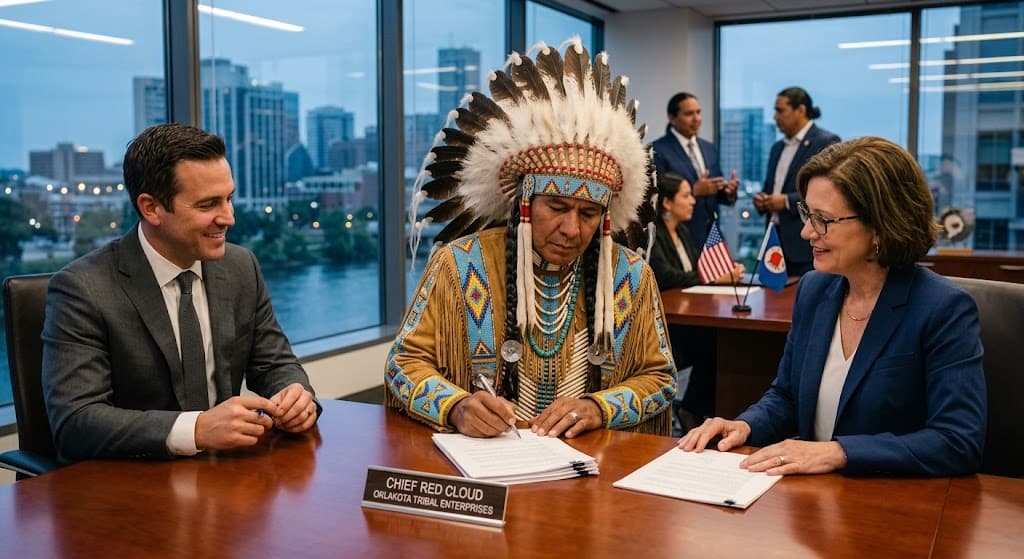
The meeting was a private roundtable. The CFTC chair was present. Seventeen organizations representing tribal nations across the United States were present. The Oklahoma Indian Gaming Association's own chairman, Matthew L. Morgan, moderated the discussion.
The topics covered were specific: CFTC rulemakings on prediction markets, tribal concerns around sports contracts specifically, tribal concerns around political and other event contracts, advertising on tribal land, and policy ideas around agricultural markets.
The fact that advertising on tribal land was on the agenda is not a minor detail. It means the tribes are contesting the CFTC's authority not just over the contracts themselves but over how those contracts are promoted in physical jurisdictions where tribal gaming law currently controls. If a Kalshi or Polymarket advertisement runs on tribal land for a product the tribes view as illegal Class III gaming, the legal question is not just federal versus federal. It is federal versus sovereign.
Morgan was careful in his public statement to separate his role as moderator from OIGA's institutional position. He stated explicitly that as moderator he left substantive discussion to the tribal organization leaders. Then he stated OIGA's position anyway, because the position is too direct to leave implied. OIGA expects the CFTC's current rulemaking to produce additional litigation. When finalized, not if.
The Legal Theory the Tribes Are Running
The Indian Gaming Regulatory Act of 1988 is the federal statute that governs gaming on tribal lands. It established a framework where Class I gaming, traditional ceremonial games, is under tribal jurisdiction exclusively. Class II gaming, bingo and similar games, operates under tribal and federal regulatory oversight. Class III gaming, casino-style games, slot machines, and sports wagering, requires a compact between the tribe and the state where the land is located.
Class III is where the revenue lives. Casino operations, table games, and sports wagering on tribal lands generate the income that funds tribal government programs, health services, education, and infrastructure. The compacts that authorize this gaming were negotiated over decades, often against significant opposition, and the revenue they protect represents the financial foundation of tribal self-governance for many nations.
OIGA's position is that sports event prediction contracts are Class III gaming operating outside the compact framework. The CFTC's position is that these are financial products regulated under the Commodity Exchange Act. Those two positions cannot both be correct. One federal statutory framework governs or the other does. The tribes are arguing the CFTC is wrong about which one, and they are promising to test that argument in court.
The "arbitrary, capricious, and not in accord with law" language is not rhetorical. It is the exact language used to challenge federal agency action under the Administrative Procedure Act. An agency rule that a court finds arbitrary and capricious is vacated. The tribes are stating their litigation theory in public before the rule is even finalized.
Why 17 Organizations at One Meeting Is the Number to Notice
Tribal gaming interests are not always unified. Different nations operate under different compacts, in different states, with different economic profiles and different political relationships with their state governments. Getting 17 organizations into the same room, with the same message, delivered to the same regulator, is organizational coordination that takes time and represents genuine consensus.
The prediction markets industry, and specifically Kalshi, has been fighting its legal battles against state gaming regulators one state at a time. New Jersey. Nevada. The pattern has been individual state challenges, which Kalshi has defended by arguing that CFTC authorization preempts state gaming law. That argument has had mixed results in court.
Tribal nations are not state gaming regulators. Their legal status is sovereign. The federal trust relationship between the United States government and tribal nations is constitutionally grounded in a way that state regulatory authority is not. A challenge to CFTC rulemaking that is filed by sovereign nations invoking their rights under a federal statute is a different category of legal challenge from a state gaming board arguing its licensing requirements apply.
The tribes are not joining a state-level enforcement action. They are contesting the CFTC's authority at the federal level, under federal law, as sovereigns. That is a harder challenge for the prediction markets industry to respond to with the preemption arguments that have worked against state regulators.
The Revenue Argument That Drives the Political Intensity
OIGA's statement describes the revenue streams at stake as "critical to Tribal government programs and services." That framing is accurate in a way that non-tribal gaming revenue is not.
For a commercial casino operator, sports wagering revenue is profit. For a tribal government, the equivalent revenue funds the programs that the federal government promised to fund and largely does not. Health clinics. Schools. Roads. Housing. The Indian gaming compact framework exists precisely because the federal government's track record of funding tribal services through direct appropriations has been inadequate. The gaming revenue is not an amenity. It is the budget.
When tribal leaders describe CFTC-regulated sports prediction contracts as undermining revenue streams critical to tribal government programs, they are describing a direct impact on the services that flow to tribal members who have no alternative source for those services. The political intensity behind the legal challenge reflects that. This is not a business dispute over market access. It is a dispute over the financial infrastructure of sovereign governments.
That context is what makes the roundtable's framing more confrontational than the polished language of official statements suggests. The tribes did not come to Washington to negotiate a carve-out or seek a compromise position. They came to deliver a message to the regulator and establish a record that they made their position clear before litigation begins.
What the CFTC Rulemaking Timeline Means in Practice
The CFTC has been working through its rulemaking on event contracts for political and sports outcomes since the question of its authority became live following Kalshi's legal victories against the CFTC's own earlier restrictions. The rulemaking process under the Administrative Procedure Act requires notice, a comment period, and a final rule. Once the final rule is published, the clock starts on legal challenges.
OIGA's statement that they "expect the CFTC's current rule making will result in additional litigation" tells you the challenge is coming regardless of what the final rule contains. The tribal nations have already determined that the CFTC's statutory authority does not extend to authorizing sports event prediction contracts in a way that overrides their rights under the Indian Gaming Regulatory Act. They are communicating that conclusion to the regulator directly, in person, before the final rule exists.
The litigation they are describing would likely name the CFTC as the defendant and argue that the final rule should be vacated as arbitrary, capricious, and in conflict with the Indian Gaming Regulatory Act. If a court agreed, the regulatory authorization that Kalshi and its competitors depend on for their sports event contract business would be at risk of invalidation.
That outcome is not certain. Federal courts have shown varying levels of deference to CFTC interpretations of its own authority. But the tribes have specific advantages in this litigation context. They have standing as sovereign governments with direct economic interests. They have a federal statute, the Indian Gaming Regulatory Act, that clearly covers sports wagering and that predates the CFTC's expansion into event contracts. And they have a legal theory, arbitrary and capricious agency action, that has been successful against federal regulators in other contexts.
The Advertising Question That Nobody Is Discussing
The inclusion of prediction market advertising on tribal land in the roundtable agenda opens a front in this dispute that the industry has not yet had to address.
Currently, prediction market platforms advertise nationally. The CFTC's position is that its authorization covers these contracts across the United States. If tribal nations contest that a Kalshi advertisement promoting sports event contracts on or near tribal land constitutes promotion of illegal gaming on sovereign territory, the enforcement question becomes complicated quickly.
Tribal nations can enforce their own laws on tribal land. If OIGA's legal theory that sports prediction contracts constitute illegal Class III gaming is correct, advertising those products on tribal land could be treated as promoting illegal gaming in a jurisdiction that has its own enforcement authority. That is not a hypothetical extension of the argument. It is what follows directly from OIGA's stated position that the CFTC's rules are unlawful.
The prediction markets industry has not had to operate in a world where sovereign governments with independent enforcement authority treat its products as illegal and have meeting with the relevant federal regulator to establish that position on the record. That is now the world it is in.
The Hard Implication
There is a version of this story where the tribal nations file their challenge after the CFTC finalizes its rule, the courts find in favor of the CFTC's interpretation of its own authority, and sports prediction markets continue to scale under federal authorization. That outcome is possible. The CFTC has won statutory interpretation arguments before.
There is another version where 17 sovereign nations with standing under a federal statute, making an arbitrary and capricious argument against a regulatory determination in a federal judicial environment that has recently been more skeptical of expansive agency authority, produce a court ruling that invalidates or substantially constrains the CFTC's event contract authorization. In that version, the $49.5 billion in 30-day volume that the market just recorded is operating on regulatory foundations that a court has found unlawful.
The volume numbers from the last 30 days represent a market that is growing fast enough to attract sovereign governments as adversaries, not just state gaming boards. That is a different category of opponent, pursuing a different category of legal theory, with a different category of stake in the outcome.
The roundtable happened. The statement is public. The promise of litigation is explicit. The CFTC has now met directly with the people who intend to sue it, listened to their argument, and will continue finalizing its rule regardless. Everything that follows from that is a legal question the prediction markets industry cannot answer by growing its volume faster.
Rate this piece — one tap, no signup
Editor-in-Chief
Ezekiel Njuguna is the Editor-in-Chief of Predictions Market Fans, where he helps make probabilistic thinking clear and practical for readers. With a strong focus on quantitative research and market mechanics, he leads the site’s technical guides, including a detailed breakdown of Kalshi Combos. His writing connects economic theory with real-world trading strategy, including practical discussions of how yield-bearing tools can support active bankroll management.
The Weekly Signal
Every Friday — the week's sharpest prediction market analysis, forecasting insights, and data-driven commentary. No noise.
Disclaimer: This content is for informational and educational purposes only. It does not constitute financial advice, investment recommendations, or trading guidance. Prediction market participation involves risk of loss. Always conduct your own research before making any financial decisions.