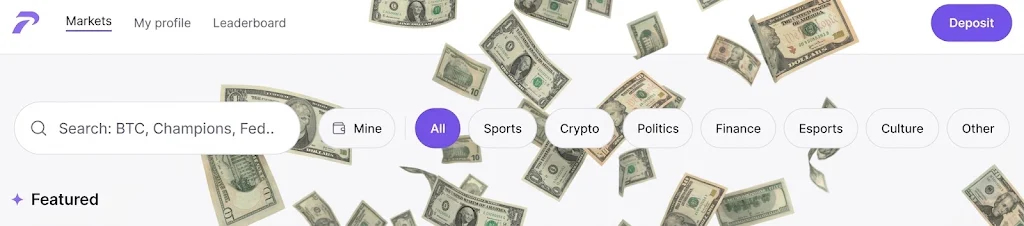
Pronostyx vs. Polymarket Comparison


If you are comparing two betting platforms, the most common approach is to do a head-to-head comparison and compare features. This approach gives you a basic idea of the differences between the two platforms, but you have no idea what it's really like to use them. To give you a better idea of what it's like to use each platform, we placed an order on both Pronostyx and Polymarket and will share what it was like to do so, from the sign-up process to the time of withdrawal.
The order we placed is a simple one: a small wager on a sports betting outcome. We've selected the sports market that a Spanish-speaking fan would want to wager on. During this process, we examine the moments when Pronostyx and Polymarket differ and their respective target markets, as well as the overlapping parts of their processes.
Polymarket is a major player in the prediction market sector, and is the reason why we have included it in our comparison. It offers a diverse range of markets, such as the NFL, NBA, MLB, soccer, UFC, and esports. The platform also covers politics, economics, crypto, culture, weather, and geopolitics. Pronostyx is a smaller platform with a more targeted focus. It offers markets on Liga MX, LaLiga, Copa Libertadores, national team football, boxing, and Caribbean baseball. In addition to this, the platform is available in Spanish and English.
It is important to keep this in mind when reading the content of this article, as it helps explain the majority of the key differences between the two betting platforms.
Stage one: Sign-up
The first part of the process is the sign-up, which varies depending on your initial approach.
The Pronostyx sign-up process is simple. You can sign up using your Google or email details and the platform will automatically generate a wallet on the Base network. No need to download browser extensions or memorize seed phrases. The process takes about a minute. If you are a seasoned crypto user, you can simply use the "Connect my wallet" feature to use your own wallet.
The sign-up is not required to view the markets, prices, and the leaderboard, so you can use the platform before making a commitment.
On the other hand, with Polymarket, you can deposit your account using a debit card, Apple Pay, PayPal, or ACH. This means you do not need to have crypto for the initial deposit. The same review for Polymarket I referenced earlier also notes that there is currently a waitlist for U.S. desktop users and recommends using the app for a faster registration process. Be sure to check the registration process for your specific area before planning your registration.
The verdict for stage one depends on your starting point. If you are a crypto user, Pronostyx offers a quicker process. On the other hand, if you wish to use a debit card and do not want to use crypto, Polymarket is the better choice.
Stage two: Deposit
When it comes to the deposit process, the two betting platforms are the most different.
Pronostyx accepts USDC (on the Base network) as a deposit method. You can deposit via a wallet (e.g., MetaMask or Coinbase Wallet) or from a crypto exchange (e.g., Binance or Kraken). You also need to have some ETH on Base for the transaction fee. The deposit page clearly displays the amount of USDC available in the Base wallet and the amount of ETH required for the gas.
The process was tested during the referenced review with a deposit of $100 USDC from a MetaMask wallet. The transfer was completed in about 30 seconds and the balance was reflected in the account immediately. Note that the transfer must be made via the same network or else the funds will not be received, so be sure to double check the network name on the deposit page.
Polymarket offers a longer list of deposit methods. You can use a debit card, ACH, Apple Pay, PayPal, wire transfer, or USDC on Polygon. The minimum deposit is $10. Some of the card deposit options go through MoonPay and may require you to buy around $20. The card depositing service may charge fees, but Polymarket does not.
This is an honest verdict. If you want to deposit in dollars via a debit card, then Polymarket is the winner. If you have some USDC (on the Base network) and want the easiest wallet-to-trade process, then Pronostyx is the winner.
Stage three: First Trade
Now we arrive at the stage that ultimately determines whether you will find yourself comfortable with the platform.
When you place a bet on Pronostyx, the betting slip provides the potential winnings for your wager. You select your bet option, wager amount, and the site provides the price, quantity of contracts, and payout for the bet. The pre-set wager amounts ($5, $10, $25, $50, or custom) also make it easy to place your first bet. If you wager $10 at 26 cents, you can buy 38.46 contracts and receive $38.46 if your Yes option is successful. Everything is clear before you place the wager, so you will not be surprised when the amount is deducted from your balance.
When viewing the market page, the page is divided into two halves. The left side displays the market info, big percentage, historical price, and a chart. The right side displays the trading panel. For example, I opened a market, with Yes priced at 50.2 cents and a payout of ~1.99x and No priced at 49.8 cents with a payout of ~2.01x. The multiplier values were shown next to the price, so I did not have to do the calculation mentally.
The trading interface on Polymarket is also clean and easy to use. In my review, I noted that it has an intuitive interface, with straightforward filtering by categories, and that trading takes only a few clicks. Even on markets with high activity, market pages are easy to read. Both platforms allow a beginner to start trading quickly.
Where they differ is in the information that the platform displays on the trading screen. Pronostyx shows you the payout and explanatory information directly on your betting ticket. This is a much more helpful display for an individual just starting out in prediction markets.
Step four: understanding the prices
While both platforms are order-book marketplaces, they display the order book a little differently, and the differences matter.
On Pronostyx, the prominent percentage on a market is an indicator that serves as a summary of the midpoint of the order book. The actual prices for each side of the market are shown in the Buy buttons, and those prices don't have to add up to 100 cents. For example, in the Bitcoin market on Pronostyx, Yes is 26 cents and No is 78 cents, for a total of 104 cents. That 4-cent difference is a true slippage that traders pay if they buy both sides, which Pronostyx transparently shows you.
The price change indicator is also easy to understand. It is shown as a number of "pts" that represent how much the likelihood of Yes has changed over the last 24 hours. So, a market that moved from 60 percent to 50 percent would be displayed as minus 10 points, in red. In newer markets, the indicator shows a shorter timeframe, such as "in 5 h," because there is less history for them to base the number on.
Polymarket, meanwhile, shows prices and the order book with a similar level of complexity and detail. In my review, I noted that liquidity is one of the platform's strongest points in the prediction market space, especially in politics, sports, crypto, and economics. For larger markets, liquidity is usually good, with tight spreads and a deep order book, while smaller markets can be thinner. Regardless of the platform, you should always check the spread before you trade.
So in practice, Pronostyx is more transparent with the prices, which is helpful for a beginner to understand what the prices mean, while Polymarket has a deeper order book, which is beneficial when trading larger position sizes without slippage.
Step five: payout and settlement rules
Settlement is when your trade turns into real money, so it's important to understand the rules. On Pronostyx, settlement rules are explained for each market. Crypto markets are settled by the Pyth price oracle, while sports markets are settled by official results.
Pronostyx says that it doesn't determine winning contracts. Instead, once the settlement source publishes results, winning contracts are unlocked. You then sign off on settlement for a specific market from the market page or your portfolio, and funds are then transferred to your available balance. Unsettled funds are still locked in contracts, so be sure to check your portfolio after each market closes.
On Polymarket, markets are resolved based on written criteria specific to each market. The criteria identify the settlement source, deadline, and any edge cases that could affect settlement. For simple events, such as sports games, settlement is straightforward. For complex events, such as politics or global happenings, it's important to read the fine print before you trade.
Pronostyx also has an advantage here in that it has a two-balance system. Funds in your available balance are transferable right away, while funds in your open balance can only be transferred when the market settles or when you sell. Understanding which balance your funds are in can help prevent surprises when you're trying to withdraw funds.
Step six: withdrawals
The last step is often overlooked in traders' planning, but it's where a platform's promises are truly put to the test.
On Pronostyx, to withdraw funds from your wallet, go to the Withdraw section. Here you enter an amount and destination address. Only your available balance can be withdrawn. In the test I performed, according to my review, I withdrew $30 to a MetaMask wallet on Base, and funds arrived in around 30 seconds.
Funds also immediately showed up on the ledger. Make sure the networks line up, as not all exchanges have support for USDC on Base. Polymarket, on the other hand, has a more unclear withdrawal process. The payment table indicates that withdrawals are instant, while the text indicates that funds are typically transferred through a self-custody wallet, before you convert them back into cash.
These two explanations don't match, so test withdrawing a small amount of funds from your own account first before relying on either one. Both platforms also allow you to liquidate your position before settlement through selling. On Pronostyx, the selling interface provides a clear explanation of the process, rather than simply providing an error message if there are no contracts in your account. This makes for a good learning experience for new traders, who want to understand how exits work.
Trading fees
Fees are the number people ask about first, so here is the comparison on that point.
Pronostyx did not list platform fees on the deposit, trading, and withdrawal screens in the review. Your costs come from elsewhere: the ETH network fee on Base, any fee on a card purchase inside a wallet app, any withdrawal fee from an exchange, and the spread between the two buy prices.
Polymarket charges nothing on maker orders, which sit on the book and wait to be matched, and those can earn rebates. Taker orders, which fill immediately, pay a fee that depends on the category. The review lists peak taker rates of 0.75 percent for sports, 1.00 percent for politics, 1.00 percent for finance and tech, 1.25 percent for culture and weather, 1.50 percent for economics, and 1.80 percent for crypto. Geopolitical markets carry no fee. Fees peak near 50 cents and shrink toward the extremes. Polymarket does not charge its own deposit or withdrawal fees.
On paper, Pronostyx shows the simpler cost line. Polymarket’s cost depends on the category you trade and whether you place limit orders. If you trade sports on Polymarket and place resting orders, you can avoid the taker fee. If you want a clean ticket with no platform fee, Pronostyx’s list is easier to read.
Support and trust
Pronostyx offers support via email at [email protected]. During my review, the response time was less than two minutes. Polymarket provides live chat on the website (not the app), Discord tickets, email, and an X account. It does not offer a phone number, and response times are reported to be slower during high traffic periods.
The regulatory story is different. In the review, Polymarket is described as a CFTC-regulated designated contract market. It was fined in 2022 by the Commodity Futures Trading Commission for doing business without proper registration, but has returned to the U.S. market in 2025. Pronostyx is a limited liability company registered in Wyoming, United States, operating under the name Pelara Digital LLC.
The pages reviewed did not mention Pronostyx's regulatory status, so that is where it has the most to catch up on. If regulation is your top priority, this is a very important consideration. Where should you begin? If you bet on Spanish-speaking football or boxing and have USDC on Base or can get it there and want to see the payout before confirming the bet, begin with Pronostyx. You're betting on the sports you're interested in, the platform is in your language, and you can read the payout on the ticket.
If you'd rather pay with a credit card, want the most liquidity, and are betting on politics, economics, or sports in the U.S., begin with Polymarket. It is the larger platform with the more varied offering and the better regulatory track record described in the review. If you want to use both, track your bets on each account separately and familiarize yourself with the terms of each market before betting.
Before you deposit
You must be over 18 and allowed to use prediction markets in your jurisdiction. The rules vary from one country to another, and a few Spanish-speaking countries limit the promotion of gambling products.
Pronostyx(WHICH YOU CAN FIND USING THIS LINK) allows you to deposit USDC only on the Base network. Be sure to check which network you are depositing on each time. Review the terms of liability and the market resolution rules. Budget your bet before you deposit. Either platform can wipe out your entire investment.
Pronostyx does not offer leverage or debt, and you will not lose more than your stake, but your entire stake can be lost.
Rate this piece — one tap, no signup
Editor-in-Chief
Ezekiel Njuguna is the Editor-in-Chief of Predictions Market Fans, where he helps make probabilistic thinking clear and practical for readers. With a strong focus on quantitative research and market mechanics, he leads the site’s technical guides, including a detailed breakdown of Kalshi Combos. His writing connects economic theory with real-world trading strategy, including practical discussions of how yield-bearing tools can support active bankroll management.
The Weekly Signal
Every Friday — the week's sharpest prediction market analysis, forecasting insights, and data-driven commentary. No noise.
Disclaimer: This content is for informational and educational purposes only. It does not constitute financial advice, investment recommendations, or trading guidance. Prediction market participation involves risk of loss. Always conduct your own research before making any financial decisions.